 EN

In commercial brewery operations, oxygen is the ultimate enemy of package stability and liquid quality. While the primary pillar page of ACE-FILLING covers the complete macro purchasing framework, layout engineering, and line integration for our
If dissolved oxygen control is neglected during bottling, even the finest craft brew or standard lager will suffer rapid flavor degradation, off-flavors (such as cardboard or papery notes from trans-2-nonenal), and premature haze formation. Understanding the mechanical mechanisms of oxygen ingress and applying rigorous control standards across your automatic beer bottling machine is vital to protecting your brewery's brand reputation and maximizing distribution shelf life.
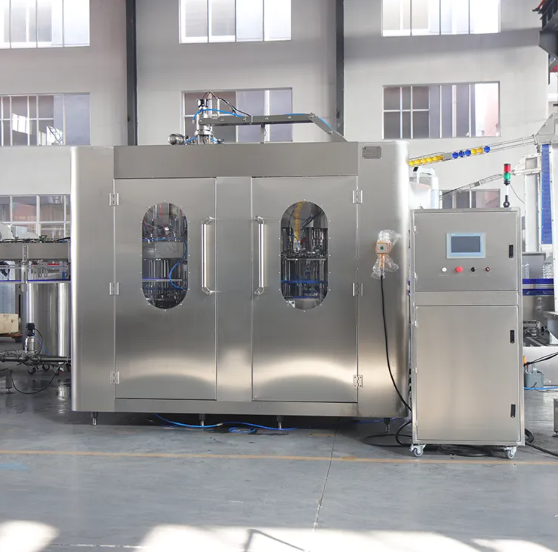
The Chemistry of Stale Beer: TPO vs. Dissolved Oxygen (DO)
To design an effective automatic beer bottling machine, engineers must differentiate between two distinct parameters that constitute total packed oxygen (TPO):
-
Dissolved Oxygen (DO): Oxygen trapped directly within the liquid matrix prior to and during the filling cycle.
-
Headspace Oxygen (HO): Oxygen residing in the gas space between the fill line and the crown cap seal.
TPO (Total Packed Oxygen) = DO (Dissolved Oxygen) + HO (Headspace Oxygen)
When beer enters an automatic beer bottling machine, contact with ambient air rapidly increases DO. Once capped, headspace oxygen slowly dissolves into the beer over days and weeks. Under room temperature distribution (20°C to 25°C), every 10 ppb increase in TPO accelerates lipid oxidation, leading to loss of fresh hop aromatics, darkening of beer color, and severe foam instability. International brewing standards (such as EBC and ASBC guidelines) dictate that commercial bottling lines maintain a total TPO below 30-50 ppb at output. Achieving this target requires targeted mechanical interventions at every mechanical valve contact point.
Technical Solutions in ACE-FILLING Iso-Barometric Systems
Achieving world-class dissolved oxygen control requires a multi-stage mechanical evacuation and purging system integrated into the isobarometric filling valve. At ACE-FILLING, our packaging line engineers implement a strict double pre-evacuation routine before liquid transfer begins:
-
Empty Bottle Infeed: Bottles enter the filling station cleanly aligned.
-
Stage 1 - Vacuum Pump Pre-Evacuation: Removes ~90% of ambient air inside the glass container.
-
Stage 2 - CO2 Purge Cycle: Flushes remaining O2 out with sterile carbon dioxide.
-
Stage 3 - Secondary Vacuum Evacuation: Reaches less than 0.1 bar residual pressure inside the bottle.
-
Stage 4 - Counter-Pressure Equalization & Gentle Filling: Equalizes pressure before smooth, laminar flow liquid fill.
-
Stage 5 - High-Pressure Hot Water Jetting (Fobbing): Creates controlled foaming right before crowning to purge neck air.
1. Double Vacuum Pre-Evacuation Routine
A single vacuum pull leaves up to 10% residual air inside the glass container. An automatic beer bottling machine equipped with double pre-evacuation first draws a vacuum down to 0.15 bar, flushes the bottle with sterile CO2, and then draws a second vacuum down to 0.08 bar. This dual-cycle process eliminates over 99% of ambient oxygen from the empty bottle before any beer contacts the glass wall.
2. High-Pressure Hot Water Excitation (Fobbing)
Controlling oxygen in the bottle neck headspace is as vital as dissolved oxygen control in the liquid body. Right before the bottle enters the crowning turret, an automated high-pressure hot water jet (80°C at 6-8 bar) injects a tiny droplet into the bottle neck. This triggers rapid, controlled foaming ("fobbing"), which drives all ambient gas out of the neck, filling the headspace pure with CO2 foam right before the crown cap is pressed.
Oxygen Control Performance Comparison Matrix
The table below outlines how different filling technologies handle total packed oxygen TPO and dissolved oxygen control across a standard
| Technology & Method | Pre-Evacuation Vacuum Level | Headspace Treatment | Average TPO Contribution | Expected Shelf Life Stability |
| Standard Atmospheric Gravity Filling | None | None | Greater than 250 ppb | Less than 30 Days (Rapid Staling) |
| Single Pre-Evacuation Counter Pressure | -0.8 bar | Low-Pressure CO2 Flush | 60-90 ppb | 3-6 Months |
| ACE-FILLING Double Pre-Evacuation + Hot Water Jetting | -0.95 bar (Dual) | Ultrasonic/High-Pressure Fobbing | Less than 30 ppb | 12+ Months (Export Quality) |
Quality Control, Testing, and BRC/FDA Factory Standards
To verify dissolved oxygen control in real-time, ACE-FILLING integrates inline optical sensors and laboratory testing protocols directly into the automatic beer bottling machine commissioning phase:
-
In-Line Luminescence Sensors: Optical sensors fitted inside the filler manifold monitor dissolved oxygen control continuously without touching the beer stream.
-
Piercing NDIR TPO Analyzers: Quality assurance staff sample capped bottles directly off the exit conveyor to measure total packed oxygen TPO using Non-Dispersive Infrared spectroscopy.
-
Clean-In-Place (CIP) Validation: All vacuum pipes, gas channels, and liquid manifolds conform to FDA 21 CFR food contact standards and BRCGS Packaging Materials hygiene protocols. Automated 85°C hot water CIP cycles prevent bio-film accumulation that could otherwise trap micro-bubbles and compromise dissolved oxygen control during long production runs.
Field Case Study: Craft Brewery Reduces TPO by 70%
Client Profile
A medium-sized craft brewery in Germany upgraded their packaging line to expand regional export distribution. Their existing legacy filling system produced inconsistent TPO levels averaging 110 ppb, causing notable flavor breakdown after 60 days in warm logistics channels.
Solution & Results
The brewery replaced their legacy line with an ACE-FILLING 18-head automatic beer bottling machine featuring dual pre-evacuation and precision fobbing control.
-
TPO Reduction: Total packed oxygen TPO dropped from 110 ppb to an average of 24 ppb.
-
Flavor Retention: Blind tasting panels confirmed zero cardboard off-notes after 9 months of ambient storage.
-
Operational Savings: CO2 consumption optimized by 18% due to precise valve timing and sealed vacuum recirculation loops.
Summary & Integration with Your Overall Packaging Line
Maintaining strict dissolved oxygen control is not just a technical luxury—it is an absolute requirement for modern breweries aiming to scale distribution and preserve product integrity. By selecting an automatic beer bottling machine engineered with dual vacuum pre-evacuation, sanitary isobarometric filling valves, and high-precision hot water fobbing, beverage manufacturers can secure low total packed oxygen TPO levels batch after batch.
For a broader look at complete plant layout design, conveyor synchronization, and auxiliary equipment choices (such as bottle washers and flash pasteurizers), explore our core

 Hot News








