 EN

Achieving high throughput while maintaining volumetric accuracy is a primary engineering goal for modern liquid packaging operations. While the comprehensive pillar page at ACE-FILLING outlines the full machinery portfolio, plant layout engineering, and purchasing guidelines for our
Operating a high speed liquid filling machine above 200 bottles per minute (BPM) creates significant mechanical challenges, including liquid splashing, container tipping, thermal sealing inconsistency, and servo lag. Resolving these bottlenecks requires integrated mechanical engineering, advanced motion control, and strict compliance with international manufacturing standards such as ISO 9001 and FDA 21 CFR.
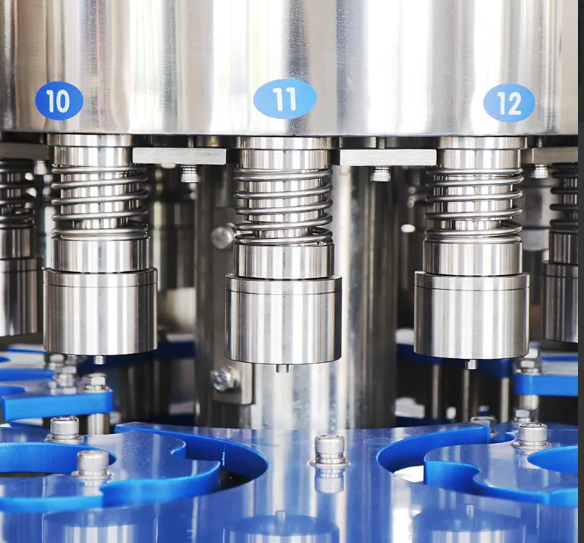
Servo Motor Synchronization and Multi-Axis Motion Control
Traditional mechanical cam systems rely on complex gear trains and chains that wear over time, introducing backlash and speed limitations. In a modern liquid filling and sealing machine, mechanical linkage is replaced by multi-axis servo driven filling equipment.
Each filling nozzle, container indexing starwheel, and sealing turret is driven by an independent Siemens or Schneider servo motor tied into a centralized EtherCAT motion controller. This electronic gearing system delivers precise speed management:
-
Zero Backlash Synchronization: Servo motors adjust speeds in real time within microsecond intervals, ensuring the bottle transfer starwheel matches nozzle movement without mechanical vibration.
-
Programmable Acceleration Profiles: S-curve acceleration and deceleration curves prevent liquid sloshing during rapid indexing, preserving precise fill levels even in low-viscosity beverages.
-
Instant Product Recipe Changes: Operators can switch bottle heights and stroke volumes via HMI touchscreens in under 5 minutes without manual tool adjustments.
Rotary Iso-Barometric and Flowmeter Nozzle Technology
The mechanical valve assembly is the core bottleneck in high-speed bottling. Conventional gravity valves cause turbulence and aeration at high flow rates. To maximize line speed on an automatic liquid packaging line, high speed systems utilize specialized dosing valves:
-
Mag-Flowmeter Dosing (Electromagnetic Flowmeters): Ideal for conductive liquids, magnetic flowmeters measure volume in real time without physical contact parts, eliminating mechanical valve wear and delivering accuracy within ±0.2%.
-
Mass Flowmeter Dosing (Coriolis Sensors): Essential for non-conductive, oils, or dense liquids, Coriolis sensors compensate automatically for liquid temperature and viscosity fluctuations.
-
Bottom-Up Diving Nozzles: To prevent foaming during high-speed delivery, servo-controlled diving nozzles submerge to the bottom of the container and lift in tandem with the rising liquid level, maintaining minimum distance between nozzle tip and product.
High Speed Sealing & Capping Turrets
Filling speed is only half the equation; container sealing must match liquid delivery without causing line backups. An advanced liquid filling and sealing machine incorporates continuous-motion rotary capping turrets engineered for extreme speed and repeatability:
-
Magnetic Hysteresis Capping Heads: Replaces friction-based mechanical clutches to apply constant application torque within ±0.5 Nm, preventing cross-threading or loose caps at speeds up to 36,000 caps per hour.
-
Ultrasonic Seal Inspection: In-line sensors verify seal integrity on foil-sealed containers, detecting pinholes or improper heat application immediately without slowing conveyor speed.
-
Pneumatic Cap Pick-and-Place: Synchronized cap chute selectors ensure every bottle neck engages a cap precisely at high linear speeds.
High Speed Filling & Sealing Feature Matrix
The comparison table below details how key engineering modules contribute to line speed and operational efficiency in a modern
| System Module | Standard Mechanical Filling | High Speed Servo & Flowmeter System | Speed & Precision Impact |
| Motion Architecture | Chain-Driven Cam Shafts | Multi-Axis EtherCAT Servo Drives | Line speed increases by 40-60% with minimal vibration |
| Dosing Method | Piston or Volumetric Cups | Electromagnetic / Mass Flowmeter | Fill accuracy within ±0.2% at up to 400 BPM |
| Nozzle Control | Fixed Mechanical Drop | Dynamic Servo Diving Nozzles | Foaming reduced by 90%, enabling faster fill cycles |
| Capping Head | Friction Mechanical Clutch | Magnetic Hysteresis Torque Head | Rejects drop by 99% during high-speed continuous motion |
Compliance, Factory Quality Testing, and Standards
Operating a liquid filling and sealing machine at elevated speeds requires robust construction materials and strict sanitary standards to withstand high production loads:
-
Sanitary Materials: All product contact components are machined from 316L stainless steel with internal surface polish exceeding Ra ≤ 0.4 µm to eliminate bacterial trap sites, meeting FDA 21 CFR Part 177 and EHEDG sanitary guidelines.
-
Vibration Analysis: Framework bases are constructed from heavy-gauge tubular stainless steel filled with sound-dampening polymers to prevent harmonic resonance at high RPMs.
-
Dynamic Balancing: Rotary fill carousels and sealing turrets undergo dynamic balancing to ISO 1940 Grade G2.5 standards to ensure smooth running over 24/7 production shifts.
Real-World Case Study: Dairy Bottler Boosts Line Speed by 50%
Client Background
A major fresh milk producer in Southeast Asia needed to replace an aging linear filling line. Their existing system capped out at 120 bottles per minute, suffered frequent foaming spillages, and required 45-minute manual changeovers between 250ml and 1L bottle formats.
Solution & Results
The producer integrated an ACE-FILLING 24-head rotary liquid filling and sealing machine equipped with magnetic flowmeters and continuous-motion capping turrets.
-
Speed Increase: Production output jumped from 120 BPM to 240 BPM on 500ml bottles without liquid splashing.
-
Downtime Reduction: Format changeover time dropped from 45 minutes to 8 minutes using stored HMI recipe profiles.
-
Spill Loss Reduction: Product loss due to overfill and foaming dropped by 85%, generating significant annual material savings.
Summary & Next Steps for Line Upgrades
Building a reliable high speed liquid filling machine requires integrating synchronized servo driven filling equipment, non-contact flowmeter dosing, dynamic diving nozzles, and magnetic capping turrets. Addressing every mechanical detail ensures your automatic liquid packaging line maintains high output without sacrificing fill accuracy or seal quality.
To explore full packaging automation, line layout optimization, and companion equipment like bottle blow molders and labeling systems, visit our dedicated
 Hot News








