 EN

Thermodynamic Fundamentals of Dissolved Oxygen Control in Beer Packaging
Minimizing oxygen ingress during commercial beer packaging is the ultimate benchmark of technical quality for modern breweries. Understanding how to reduce dissolved oxygen level while using automatic beer bottling machine systems is essential to preserving hop aroma, maintaining colloidal stability, and preventing premature flavor staling. Dissolved oxygen (DO) and Total Packaged Oxygen (TPO) trigger rapid oxidation of polyphenols and iso-alpha-acids, producing cardboard-like trans-2-nonenal off-flavors. Controlling oxygen exposure requires a rigorous engineering approach across bottle evacuation, isobaric transfer, and capping turret transitions.
Commercial bottling operations require strict alignment with international quality guidelines, such as ASBC and EBC standards. Modern isobaric filling machinery addresses beer bottling TPO reduction by implementing advanced gas displacement techniques before liquid contacts the bottle interior. Integrating double pre-evacuation beer filling technology removes residual ambient air from bottle cavities, replacing oxygen with food-grade carbon dioxide or nitrogen gas under pressure. Equipment engineered by ACE-FILLING incorporates these precise pneumatic flow pathways, establishing reliable beer bottle oxygen pick up control to ensure long-term flavor integrity and extended product shelf life.
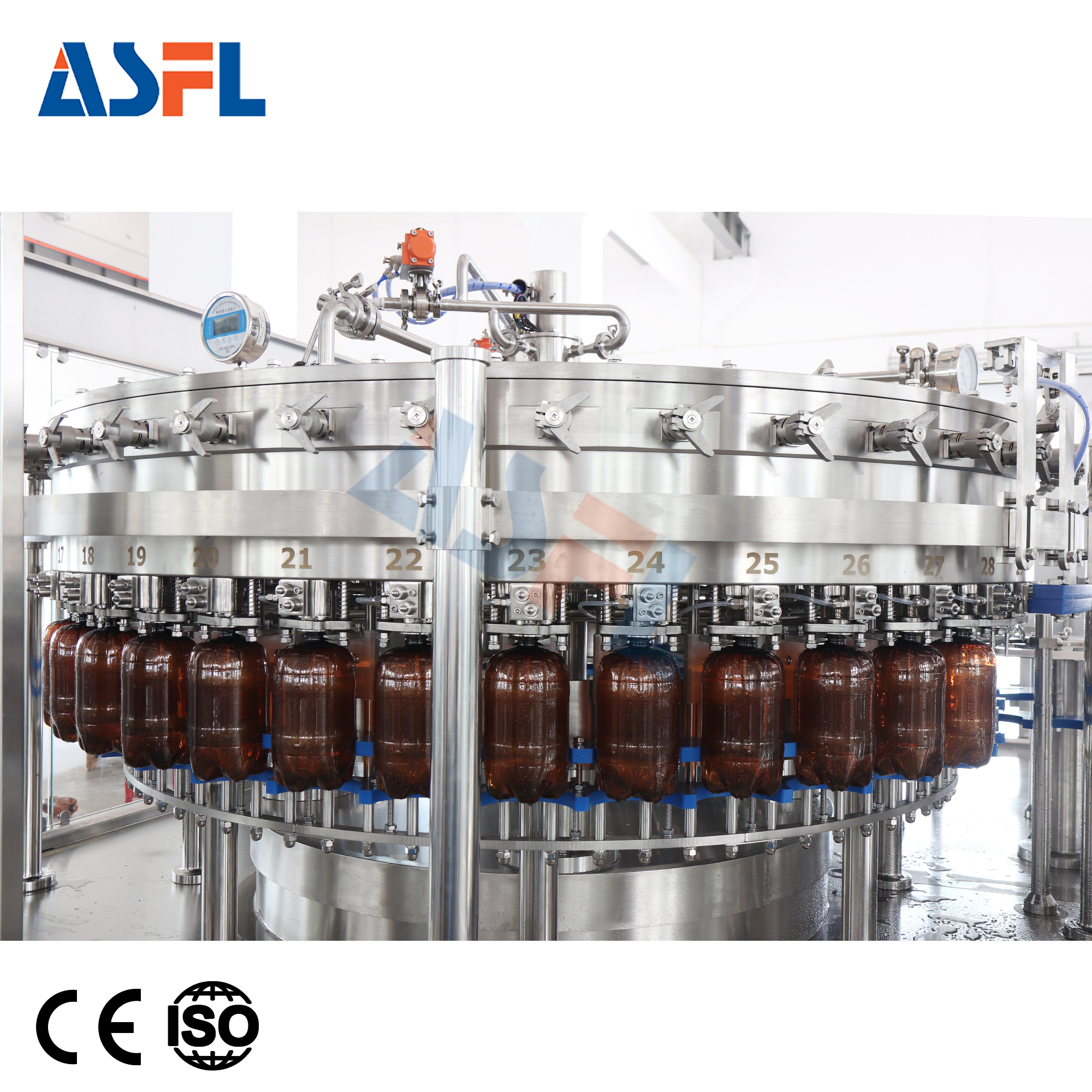
Mechanical Double Pre-Evacuation and CO2 Purging Dynamics
The primary source of oxygen pickup during filling occurs within the empty bottle cavity prior to beer injection. Achieving significant beer bottling TPO reduction requires removing atmospheric air (containing approximately 21 percent oxygen) before the isobaric filling valve opens.
-
First Pre-Evacuation Stage: A high-vacuum liquid ring pump draws a deep vacuum down to minus 0.9 bar inside the bottle cavity, evacuating over 90 percent of ambient atmospheric air.
-
Intermediary CO2 Flushing: High-purity carbon dioxide gas at 2.0 bar pressure injects into the evacuated bottle, diluting any remaining oxygen molecules across the internal surface wall.
-
Second Pre-Evacuation Cycle: The vacuum pump executes a second evacuation pull down to minus 0.9 bar, removing residual mixed gases and establishing a nearly pure carbon dioxide vacuum state.
-
Counter-Pressure Gas Balancing: Food-grade CO2 pressurizes the bottle to equalize internal pressure with the overhead beer storage bowl, allowing gravity filling to proceed under ideal gas equilibrium.
The following engineering matrix outlines the technical progression across gas displacement stages to support beer bottle oxygen pick up control:
| Evacuation & Purging Phase | System Operating Vacuum / Pressure | Residual Oxygen Concentration | Impact on Beer Bottling TPO Reduction |
| Atmospheric Baseline | 0.0 bar (Ambient Atmospheric) | ~210,000 ppm (21% O2) | Base air volume prior to executing double pre-evacuation beer filling |
| First Vacuum Evacuation | -0.88 bar to -0.90 bar | ~21,000 ppm O2 | Removes primary atmospheric air volume to reduce dissolved oxygen level while using automatic beer bottling machine setups |
| Intermediary CO2 Flush | +1.5 bar to +2.0 bar CO2 Pressurization | ~2,100 ppm O2 | Dilutes remaining atmospheric gases within the bottle cavity |
| Second Vacuum Evacuation | -0.90 bar to -0.92 bar | <300 ppm O2 | Achieves ultra-low residual oxygen boundary for superior beer bottle oxygen pick up control |
| Counter-Pressure Charge | Equalized to beer bowl pressure (+2.2 bar) | <50 ppb DO Contribution | Prepares bottle for laminar fluid fill without oxidation or gas breakout |
High-Pressure Hot Water Jetting and Headspace Air Displacement
Extensive field data demonstrates that significant oxygen pickup occurs in the short interval between the bottle leaving the filling valve and entering the capping turret. To reduce dissolved oxygen level while using automatic beer bottling machine equipment during high-speed transport, automated lines utilize high-pressure hot water jetting (fobbing).
A micro-jet of sterile, deaerated water at 80 degrees Celsius to 85 degrees Celsius and 6 to 10 bar pressure injects directly into the bottle neck liquid surface immediately prior to cap placement. This hot water pulse causes controlled foam generation (fobbing). The rising foam expands upward, completely displacing the atmospheric gas volume trapped inside the bottle headspace.
-
Deaerated Water Supply: Water fed to the jetting nozzle must pass through a vacuum deaeration membrane, maintaining DO levels below 10 parts per billion (ppb) to preserve beer bottling TPO reduction metrics.
-
Precision Jetting Nozzle Alignment: Laser-guided mechanical alignment guarantees that the hot water jet strikes the liquid center precisely, ensuring consistent foam formation without liquid spillage.
-
Synchronized Jet Pulse Timing: High-speed solenoid valves modulate jet duration dynamically relative to line speed, preventing insufficient fobbing at low speeds or foam overflow during high-speed runs.
-
Immediate Cap Placement: Reducing the transfer distance between the jetting station and the capping chuck ensures that caps seat over dense CO2-rich foam, reinforcing beer bottle oxygen pick up control.
Liquid Line Temperature Control and Dissolved Oxygen Monitoring
Maintaining strict temperature boundaries throughout beer supply piping is vital for executing double pre-evacuation beer filling cycles cleanly. Cold beer retains dissolved carbon dioxide far more effectively than warm beer. If beer temperature rises above 4 degrees Celsius during transfer from the bright beer tank (BBT) to the filler bowl, dissolved CO2 escapes from solution, creating severe liquid turbulence and surface oxidation.
-
Chilled Recirculation Jackets: Dual-walled stainless steel filler bowls feature glycol cooling jackets, maintaining beer storage temperatures between 1 degree Celsius and 3 degrees Celsius.
-
Optical Inline DO Sensors: Real-time optical luminescence oxygen sensors installed on main liquid inlet lines continuously monitor incoming beverage DO levels before valve distribution.
-
Laminar Fill Stem Profiling: Swirl-deflector filling nozzles guide beer smoothly down the inner glass wall, minimizing surface agitation and supporting attempts to reduce dissolved oxygen level while using automatic beer bottling machine carousels.
-
Pure Nitrogen Capping Barrier: Supplying a low-pressure nitrogen gas curtain over the cap chute prevents ambient air entrainment inside bottle caps prior to magnetic chuck placement.
Quality Verification and Laboratory Acceptance Protocols
To verify that beer bottle oxygen pick up control meets international brewing standards, ACE-FILLING subjects every beer bottling line to rigorous pre-dispatch laboratory testing protocols.
-
Optical TPO Meter Audits: Piercing measurement devices test filled, capped bottles across 50 consecutive stations, verifying total packaged oxygen values below 30 ppb.
-
Vacuum Holding Leak Test: Evacuation valves undergo 4-hour pressure decay testing to confirm zero ambient air infiltration through dynamic PTFE seals.
-
Continuous 24-Hour Trial Run: Complete filler and capper monoblocks undergo continuous high-speed dry and wet testing under full production loads to confirm sensor feedback and jetter synchronization.
-
Microbiological Cleanout Validation: Automated CIP manifold validation confirms 100 percent clearance of sanitizing chemicals and zero microbial swab counts post-sanitization.
Brewery owners, plant directors, and packaging engineers looking to safeguard beer freshness and optimize bottling efficiency can review complete technical specifications and equipment options at the official



 Hot News








