 EN

What Preparation Should You Make for Factory Acceptance Test of Beverage Filling Line?
A factory acceptance test (FAT) is where a planned beverage filling line becomes a working system that can be observed, measured, and discussed before shipment. For a buyer, the useful question is not whether the line starts and stops. It is whether the agreed liquid, bottle, closure, speed, controls, cleaning approach, and handoff points can be checked under conditions that resemble the intended production task.
From a packaging-line engineering coordination perspective, preparation should begin with the handoff points around the filler, not just the filler itself. A beverage filling line may include bottle handling, rinsing or treatment, filling, capping, conveying, inspection, labeling, and downstream accumulation. A problem at one handoff can make an otherwise sound machine look unstable. More accurately, the FAT should turn your purchase requirements into observable tests and documented follow-up actions.
Start with an agreed FAT protocol
Ask the supplier to circulate a draft FAT protocol early enough for both teams to comment before travel or remote witnessing is arranged. The protocol should identify the equipment scope, the planned test sequence, witnesses, acceptance criteria, data to be recorded, and the method for closing deviations. It should also state which tests are demonstrative and which are formal acceptance points.
For a beverage filling line, attach the current specification, general arrangement drawing, process-flow information, electrical documentation, utility requirements, and approved bottle and cap drawings where applicable. A generic protocol is rarely enough. Your tests need to reflect the actual liquid, container, production rhythm, and downstream equipment you will receive.
- Confirm the purchase order, latest approved scope, and revision status of each document.
- List each machine and handoff included in the FAT, plus excluded items that will be completed on site.
- Define who can accept results, who records exceptions, and who approves closure evidence.
- Agree on the test records: output log, fill measurements, alarm log, safety checklist, and punch list.
Industry FAT guidance commonly calls for current drawings, data sheets, test procedures, inspection plans, and calibration evidence for instruments used to record results. Treat this as a measurement-chain question: if a result will support acceptance, both parties should know how it was measured and whether the instrument is suitable for that measurement.
Send representative materials and specifications
Many avoidable FAT disagreements occur because the trial materials do not match production conditions. Before the visit, provide the supplier with the representative bottle, cap or closure, label if relevant, and liquid information needed to set up the beverage filling line. If you cannot ship the actual beverage, agree in writing on an acceptable substitute and describe the differences that may affect results.
At a minimum, clarify viscosity range, carbonation or foaming behavior, temperature, particulates, product sensitivity, planned fill volume, neck finish, bottle dimensions, bottle material, cap torque or sealing expectations, and target formats. If there are several stock-keeping units, decide whether the FAT will demonstrate one primary format, a changeover, or both. A claimed line speed is meaningful only when the liquid and container conditions are stated beside it.
For an automatic liquid filling machine factory trial, ask how the supplier will condition trial bottles, feed caps, recirculate or supply liquid, and manage rejects during the run. The purpose is not to recreate every site utility. It is to expose assumptions that could otherwise emerge during commissioning.
Convert capacity expectations into test conditions
Do not accept a single speed number without its operating conditions. Instead, write a run plan for the beverage filling line: the format tested, target output, run duration, permitted stoppages, product supply conditions, and the criteria for recording rejects or interventions. This makes the discussion more useful than a short high-speed demonstration.
Ask the team to distinguish between a brief mechanical peak and a stable run. During the FAT, observe whether infeed spacing, bottle transfer, filling, capping, discharge, and accumulation remain coordinated. Where practical, record the beginning and end of each planned run, the number of accepted containers, rejected containers, operator interventions, and the cause of each stop. If foam, unstable liquid level, bottle scuffing, cap-feed interruptions, or jams occur, enter them in the same log rather than settling them verbally.
A beverage filling line can meet a target only under defined conditions. That is not a weakness; it is the boundary needed to plan site utilities, staffing, and site acceptance testing sensibly.
Prepare quality checks around the filled container
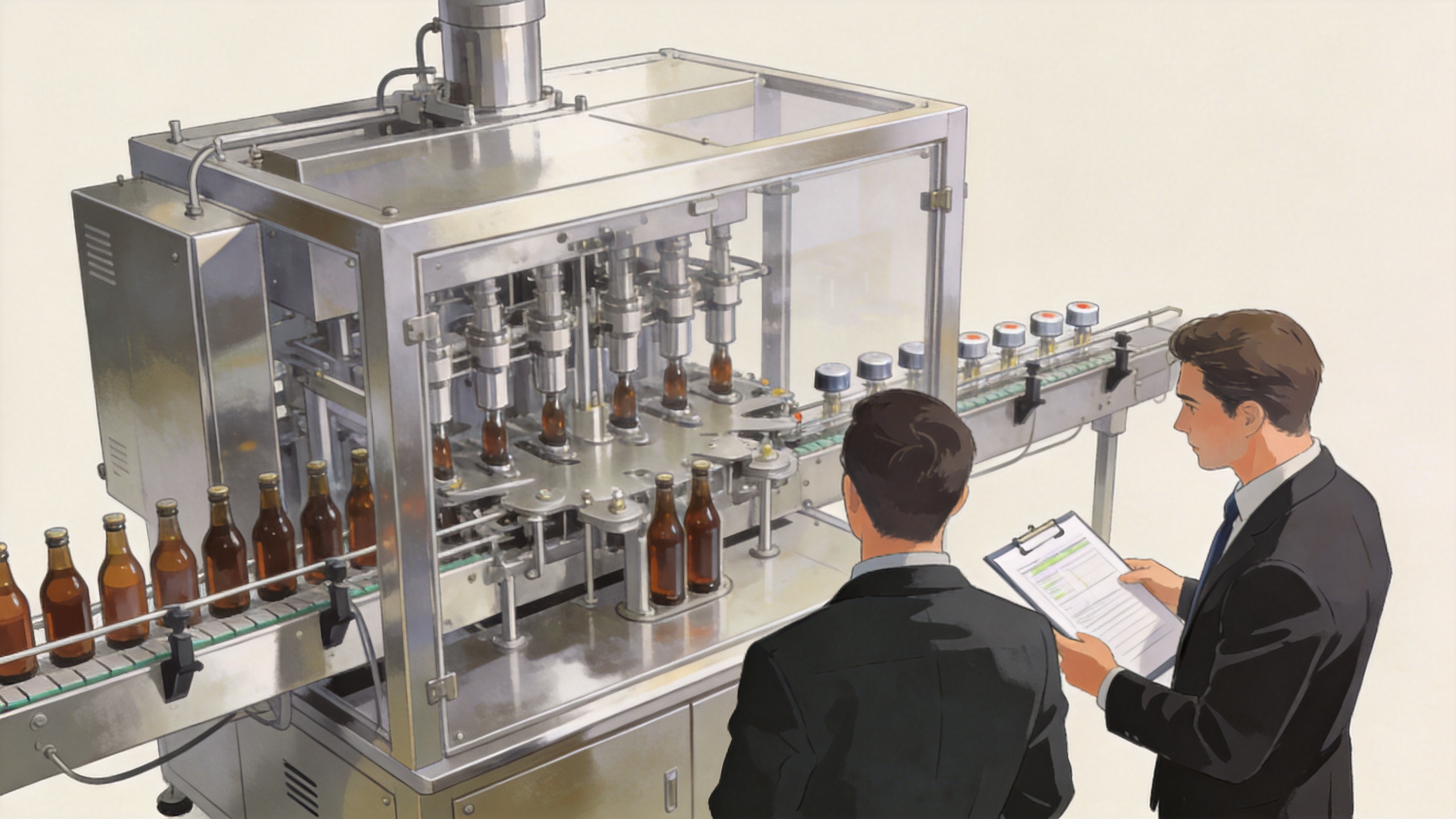
Agree beforehand which product-quality observations can be made at the factory and which require your own laboratory or site conditions. Typical FAT checks may include fill-volume sampling, visual inspection for spills or exterior wetting, cap application or sealing observations, bottle handling, reject-device response, coding or label registration if those systems are in scope, and traceability of test samples.
Specify the sampling method rather than relying on an impression. For example, decide which points in the run will be sampled, which container sizes are tested, who measures them, and how results are recorded. The appropriate limits depend on the product, package, market, and your approved specification; the supplier should not infer them from a generic test. This is particularly important when the beverage filling line handles carbonated, hot-filled, pulpy, or foam-prone beverages.
Check hygiene, cleanability, and material evidence
A beverage FAT is also the time to review cleanability and product-contact details. Hygienic-design frameworks for food and beverage equipment emphasize accessible cleaning, drainage, sealing, and avoidance of areas that can retain residue. Confirm the specific standards, certificates, and scope required for your product and destination market rather than assuming that one designation applies to every component.
For the beverage filling line, request the product-contact material list, drawings or photographs that identify relevant contact areas, cleaning or CIP sequence information where supplied, and instructions for disassembly, inspection, and reassembly. Ask practical questions: Can operators reach routine inspection points? How are change parts identified? Which seals or wear items are part of the recommended spare-parts set? What evidence will accompany the machine at shipment?
Test controls, safety, and recoverability
Before the FAT, provide the required language, recipe names, alarm philosophy, user roles, and data or communication expectations. During the test, walk through the HMI with the operator who will sign the record. Test normal start-up and shutdown, emergency-stop behavior, guards and interlocks, low-material responses, reject confirmation, alarm acknowledgement, and recovery after a controlled stop.
For a beverage filling line, recovery matters as much as normal running. Note whether the line restarts with orderly bottle flow, whether affected containers are handled as intended, and whether the operator can identify the reason for an alarm. If remote support, data exchange, or auxiliary systems are included, record the agreed boundary of that scope rather than treating it as an informal promise.
Leave with a managed punch list and handover package
No FAT needs to be treated as a pass-or-fail theatre event. A more useful outcome is a signed record of passed items, deviations, owners, target dates, and the evidence required for closure. Separate shipment-blocking issues from site-completion work. For each open item, state whether it will be re-tested before dispatch, verified remotely, or carried into the site acceptance test.
Before leaving, confirm the handover package for the beverage filling line: as-built drawings where available, manuals, spare-parts information, test records, calibration evidence relevant to the FAT, software and backup arrangements if included, packing plan, and the site commissioning plan. This creates a practical bridge from factory trial to installation.
A final buyer checklist
Bring the people who understand production, maintenance, quality, automation, and purchasing responsibilities. Bring the approved requirements, representative samples, a measurement plan, and authority to record decisions. Most importantly, define success before the line is powered up. When a beverage filling line is evaluated against agreed conditions rather than a vague demonstration, the FAT can reveal handoff issues early and make the next phase easier to manage.


 Hot News








