 EN

A 5 gallon bottling line is often evaluated by its washer, filler, capper, and stated output. That is understandable, but it leaves out the process that determines what arrives at the filler: the water-treatment supporting system. For a returnable 5-gallon container operation, the treatment skid, treated-water storage, transfer piping, and filling block are one production system. If they are specified independently, a line may look balanced on paper while operators face unstable supply, avoidable cleaning work, or repeated adjustments at startup.
From a packaging-line engineering perspective, the useful starting point is not a catalog configuration. It is the source-water report, finished-water specification, container condition, target production rhythm, and sanitation plan. This article provides a selection framework rather than a local compliance decision; final equipment selection should be verified against the actual water analysis and applicable rules.
A 5 gallon bottling line begins before the bottle washer
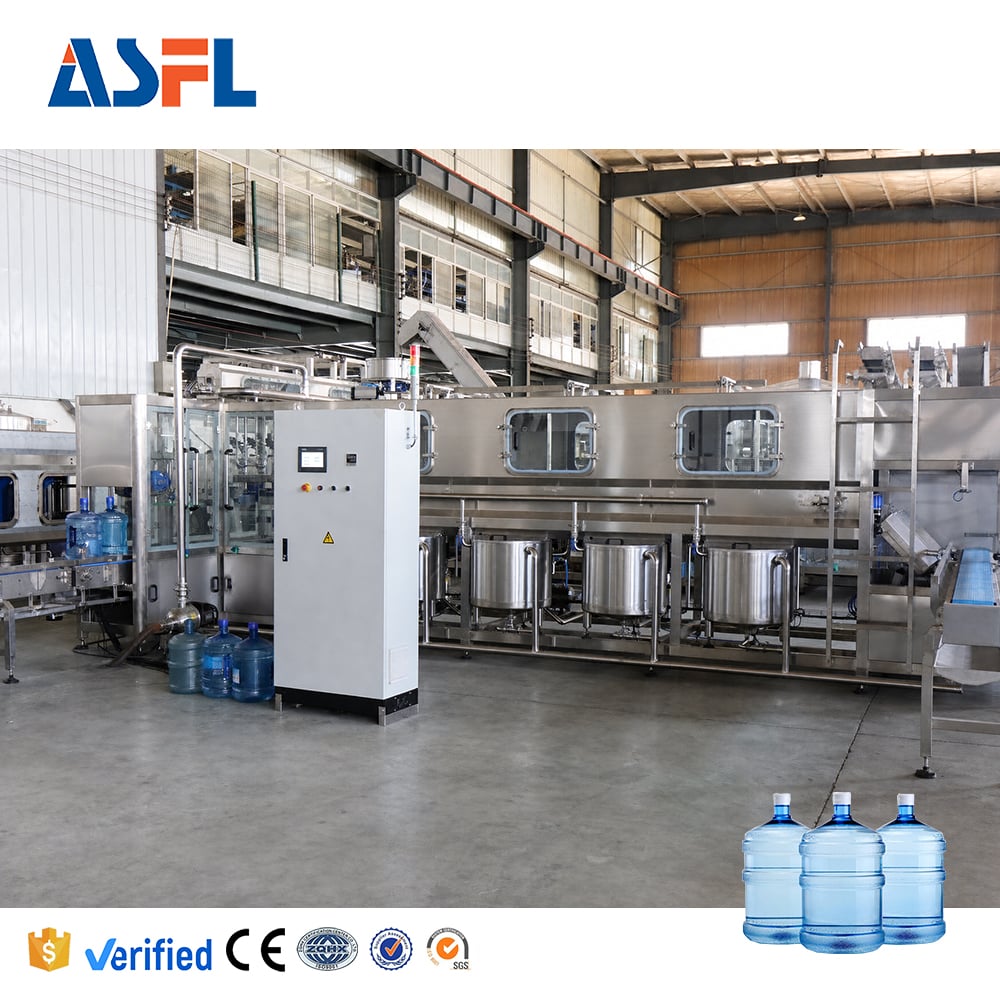
In a typical 5 gallon bottling line, empty containers are received, inspected and washed before rinsing, filling, capping, and downstream handling. The product side has its own path: raw water enters treatment, treated water is held or buffered, then it travels through hygienic transfer equipment to the filler. A short interruption on the water side can stop the filling side even if every mechanical station is available.
That is why a 5 gallon bottling line should be planned as connected equipment, not isolated machines. The treatment system must deliver water at the required quality and at a usable flow profile. The buffer tank must accommodate normal operating variation without becoming a neglected holding point. The transfer route must be cleanable and controlled. Finally, the filler must receive water at conditions that fit its process and sanitation routine.
Match treatment stages to the source-water condition
There is no single treatment recipe for every 5 gallon bottling line. Source water can differ in suspended solids, dissolved minerals, organic matter, microbial condition, taste-related compounds, and seasonal variation. A source-water analysis and intended finished-water specification should come before membrane sizing or quotations.
Depending on those findings, a supporting system may include pre-filtration, media treatment, activated carbon, membrane separation, ultraviolet treatment, ozone, or other controls. Reverse osmosis and nanofiltration are recognized drinking-water treatment technologies; UV and ozone can be used as disinfection methods in treatment plants. Their presence alone does not make a design suitable. The practical question is whether each stage addresses a documented condition and whether the downstream system can operate with its flow, pressure, cleaning, and monitoring requirements.
For example, pre-treatment may be required to protect a membrane from the feed-water conditions. If membrane recovery, flushing, or cleaning cycles reduce available flow at particular times, the 5 gallon bottling line needs enough treated-water buffer and a clear operating sequence. Otherwise, a filling machine may be blamed for a limitation originating upstream.
Capacity is a flow-and-time question, not only a nameplate number
A treatment skid and a 5 gallon bottling line can each have plausible individual capacity figures yet still be mismatched. The line does not consume water as a perfectly flat hourly average. It may draw product water during filling, use additional water during rinsing or sanitation, pause for container handling, and restart after short stops. Treatment equipment also has backwash, regeneration, flushing, or maintenance states that affect its available output.
Build the capacity discussion around a simple operating profile:
- Define the target number of filled containers per hour and the actual fill volume.
- Separate finished product water from water needed for bottle washing, rinsing, cleaning, and other plant uses.
- Identify peak draw periods, not just the planned shift average.
- Document the treatment system's usable production rate under the expected feed-water condition.
- Size treated-water storage with agreed assumptions for short interruptions, treatment cycles, and startup demand.
This approach is especially relevant when comparing a 5 gallon water filling machine turnkey proposal with a line assembled from separately purchased units. The question is not whether every supplier lists a suitable output. It is whether the water balance remains workable through the actual sequence of wash, fill, sanitation, and restart.
Design hygienic transfer from treatment to filling
Water quality can change after treatment if the treated-water path is not managed as part of the 5 gallon bottling line. Tank geometry, vents, valves, pipe routing, dead legs, recirculation arrangements, and cleaning access all deserve review. Here it helps to separate two questions: water treatment is one system, and hygienic transfer is another. Both must be compatible.
U.S. bottled drinking water regulations in 21 CFR Part 129 illustrate the broader principle that facilities, methods, practices, and controls are considered together to support sanitary processing. That reference is not a substitute for local requirements, but it explains why a treatment purchase should not end at a filtration claim. The system also needs documented cleaning responsibilities, monitoring points, and an operating routine that reaches the equipment between treatment and filling.
For a 5 gallon bottling line, review where samples can be taken, how a tank is cleaned, how a transfer loop is drained or recirculated, and how the filler is isolated for maintenance. In practice, liquid level stability depends on supply conditions. A tank may buffer flow, but it cannot compensate indefinitely for a treatment train that is undersized or frequently unavailable.
Coordinate controls, alarms, and operating responsibility
Controls are another frequent source of mismatch. A 5 gallon bottling line may have its own PLC and safety logic, while the water-treatment package uses a separate controller. That arrangement can work well when signal responsibilities are defined. It becomes difficult when the filler requests product water, a tank level falls, or the treatment skid enters a cycle and nobody has agreed which system should alarm, pause, or authorize restart.
During technical review, ask for a signal-and-responsibility list instead of relying on general automation statements. Useful points include tank level signals, low-pressure or no-flow protection, conductivity or other agreed quality-monitoring points, pump permissives, sanitation status, emergency-stop boundaries, and manual-mode rules. Automation does not remove the need for operator checks; it makes the selected checks easier to repeat and record.
Include maintenance and cleaning in the original scope
A 5 gallon water filling machine maintenance plan should include more than lubrication and change parts on the filler. It should also identify filter replacement, membrane cleaning where applicable, UV or ozone component service where applicable, instrument calibration, tank inspection, valve maintenance, and sanitation verification. The exact list depends on the selected treatment technology, but ownership should be clear before commissioning.
When considering an industrial 5 gallon water filling machine, look beyond the footprint. Equipment access, drains, chemical handling procedures, spare parts, and safe isolation points affect whether scheduled work can be completed without creating a long and unpredictable stop. A compact layout is useful only when technicians can still clean, inspect, and service the connections.
Use commissioning to verify the whole system
A 5 gallon bottling line should be accepted as an integrated process. Before final sign-off, agree on a run plan that checks treated-water availability, tank level behavior, transfer stability, bottle washing, filling, capping, and the restart sequence after a planned pause. Record the source-water conditions used for the test and the agreed finished-water checks. More accurately, the target production rhythm should be validated under stated conditions, not assumed from a machine label.
Observe the line long enough to expose normal events: treatment cycling, container interruptions, cleaning preparation, and operator handover. This turns a broad 5 gallon water filling machine turnkey discussion into verifiable acceptance items. A trial run cannot answer every future question, but it can align the parties on the conditions under which the system was evaluated.
A practical specification checklist
- Source-water analysis, expected variation, and required finished-water specification
- Target container volume, production rhythm, and peak product-water demand
- Separate water demand for product, washing, rinsing, cleaning, and utilities
- Treatment stages, usable output, cycle effects, and treated-water buffer assumptions
- Tank, piping, valves, vents, sampling, drainage, and cleanability requirements
- Control signals, alarms, interlocks, and manual operating responsibilities
- Commissioning records, routine monitoring, service tasks, and spare-parts scope
Plan the supporting system as part of the line
The central lesson is straightforward: a 5 gallon bottling line needs a matched water-treatment supporting system because product quality, production continuity, and cleaning discipline depend on those connections. A filling block cannot correct an unstable water supply, and a treatment skid cannot deliver its intended result through unsuitable storage and transfer paths.
Start with the source-water report and operating target, then turn those inputs into a joint water balance, hygienic layout, control list, and acceptance plan. If those elements are agreed before fabrication, the resulting 5 gallon bottling line is easier to commission, operate, and maintain within its stated conditions.




 Hot News








