 EN

What Are the Unique Maintenance Needs of a Glass Bottle Filling Machine
A glass bottle filling machine needs more than a generic lubrication schedule. Glass is rigid, abrasive when chips are present, and less forgiving of poor bottle guidance than many lightweight containers. The most useful maintenance program therefore connects sanitation, bottle handling, filling accuracy, and safe cleanup rather than treating the filler as an isolated unit. For a line manager, the practical question is not simply how often to service a glass bottle filling machine; it is which checks prevent a small alignment or cleanliness problem from becoming lost production.
From a maintenance-planning perspective, start with the product, the bottle, and the line conditions. A still-water line and a carbonated beverage line may share mechanical components, but their cleaning sequence, pressure-related checks, and validation needs can differ. The same is true for a glass bottle water filling machine: water does not remove the need to inspect contact surfaces, rinse quality, and bottle debris control.
Why glass changes the maintenance priority
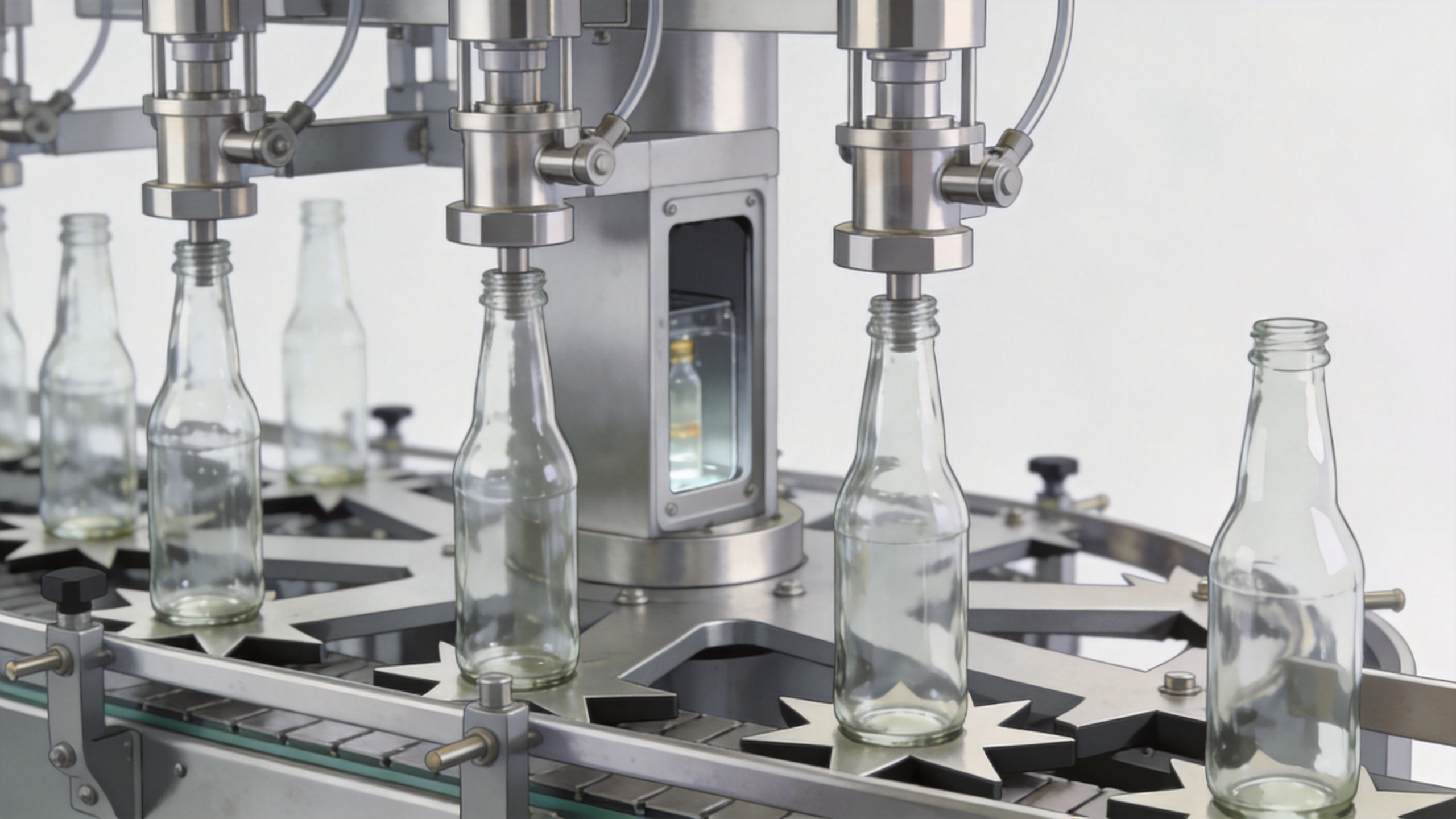
Glass bottles create several maintenance concerns that deserve their own work instructions. Bottle height, neck finish, base shape, and dimensional variation affect guide rails, starwheels, infeed screws, lift cylinders, and centering devices. A worn guide, a misaligned starwheel pocket, or an incorrect change part can allow bottles to rub, tip, or collide. That raises breakage risk and can spread fragments or fine glass dust into areas that take time to clean and inspect.
For this reason, a glass bottle filling machine should be checked at the interfaces where containers change direction or elevation, not only at the filling valves. Inspect rails and wear strips for sharp edges, examine starwheel and bottle-pocket surfaces for damage, and confirm that guards, sensors, and rejection paths are clear. Record recurring breakage by location. A pattern near the infeed points to different checks than a pattern near discharge or capping.
It is also worth separating two ideas: a line can be clean enough to look acceptable while its bottle handling is still unstable. More accurately, cleanability and alignment must be reviewed together because a collision point can introduce a sanitation burden that is not obvious during normal running.
Build sanitation into preventive maintenance
Every maintenance plan for a glass bottle filling machine should distinguish between routine cleaning, sanitation verification, and mechanical service. The exact chemicals, temperatures, concentrations, contact times, and frequency must come from the product, machine supplier, and site sanitation program. Do not copy a generic interval into a food or beverage process without validating it.
As a useful design reference for U.S. food operations, 21 CFR 117.40 requires equipment to be adequately cleanable and maintained to protect against contamination. It also addresses corrosion-resistant food-contact surfaces and seams that minimize accumulation of organic material. That does not prescribe a single cleaning schedule for every facility, but it supports a practical rule: inspect areas that can trap product, rinse water, labels, or glass debris before returning the machine to service.
Focus the cleaning checklist on filling nozzles, valves, manifolds, product hoses, tank fittings, drip trays, bottle rinse components, and nearby non-contact surfaces. Confirm that seals are intact and that dismantled parts are reassembled correctly. If a glass bottle water filling machine uses compressed air near product or contact surfaces, the air treatment and point-of-use condition should be part of the documented check, not an assumption.
Protect filling accuracy by maintaining the product path
Filling consistency depends on more than a setpoint. On a glass bottle filling machine, inspect valves, valve seats, O-rings, springs, flow-control parts, level probes, and any vacuum or return-gas connections according to the approved machine documentation. Wear, residue, or a damaged seal can cause drips, variable fill levels, foaming, or inconsistent shutoff. These symptoms should trigger a structured check of product conditions and valve condition before operators change several settings at once.
Keep a small record for each event: product type, bottle format, line speed, affected heads, visible symptom, corrective action, and verification result. This makes the maintenance history useful for identifying a recurring head or condition. It also prevents a common mistake—assuming the filler is at fault when an unstable supply, bottle-positioning issue, or downstream stoppage is influencing the result.
Make change parts and bottle guidance a controlled maintenance item
Changeover parts are often treated as production tooling, but they are central to maintaining a glass bottle filling machine. Label and store starwheels, guides, neck-handling parts, and infeed screws so they cannot be mixed between formats. Before a restart, check for chips, cracks, burrs, loose fasteners, and correct fit. A short first-run observation at normal speed is usually more informative than relying only on a static setup.
During a format change, inspect bottle spacing through the infeed, transfer, filling, and discharge zones. Watch for scuffing, neck contact, hesitation, and bottle rotation that should not be happening. The goal is not merely to achieve motion; it is to maintain controlled motion without creating contact that will wear parts or stress glass.
Use a practical inspection rhythm
| When | What to verify | Why it matters |
|---|---|---|
| Before startup | Guards, bottle path, nozzles, seals, drip areas, and visible debris | Finds unsafe or unsanitary conditions before bottles enter the filler. |
| During production | Bottle stability, fill behavior, leaks, unusual noise, and reject patterns | Helps isolate a developing mechanical or process problem early. |
| After cleaning or changeover | Reassembly, change-part condition, sensor positions, and trial-run results | Reduces errors introduced while the glass bottle filling machine was open. |
| Planned shutdown | Lubrication points, bearings, chains, belts, fasteners, and wear components | Lets the team replace parts based on condition and supplier guidance. |
Respond safely to glass breakage
Breakage response is a defining maintenance need for glass lines. Stop or control the line according to the site procedure, isolate the affected zone, remove broken containers with approved tools and PPE, and clean the area using the plant’s validated method. Do not rush a restart because the bottle path looks clear. Inspect nearby rails, pockets, nozzles, and shields for chips or lodged fragments, then document the event and the likely cause.
Repeated breakage is a maintenance signal. Check bottle supply quality, guide alignment, timing, worn parts, conveyor transitions, and line-speed interactions. In a glass bottle water filling machine, this review should also include the rinser-to-filler transfer because wet surfaces can change how bottles behave.
A maintenance plan that supports reliable production
An effective maintenance program for a glass bottle filling machine is specific enough to guide daily work but flexible enough to reflect actual bottle formats, products, and operating conditions. Start with prevention: maintain cleanable contact surfaces, protect the bottle path, inspect change parts, and trend recurring faults. Then use the recorded evidence to decide whether a problem belongs to sanitation, filling components, or container handling.
Before setting a final service interval, ask whether your team has confirmed the bottle drawings, liquid characteristics, cleaning method, target speed, and access around the machine. That information turns a generic checklist into a practical plan for a glass bottle filling machine and helps keep maintenance decisions grounded in the real line.

 Hot News








