 EN

Why mineral water filling line needs inline water quality monitoring module
A mineral water filling line is often specified around rinsing, filling, capping, conveying, and output speed. Yet the water itself is the process input that connects every one of those stations. If its condition moves outside the operating window, a line can continue to run while the team loses early visibility of a developing issue. That is why an inline water quality monitoring module deserves consideration as part of the control architecture, not as an accessory added after commissioning.
From a packaging-line engineering perspective, the useful question is not whether one sensor can certify finished water. It cannot. The better question is whether the mineral water filling line can detect meaningful process changes soon enough to hold product, investigate the cause, and document the response. Laboratory testing and scheduled sampling remain necessary; inline measurement adds continuous operational feedback between those checks.
What the module adds to a mineral water filling line
An inline module brings selected measurements from a periodic activity into the operating routine. Depending on the source-water profile, treatment process, and local requirements, the monitored signals may include conductivity, pH, turbidity, temperature, flow, pressure, disinfectant-related parameters, or other application-specific indicators. The correct list is site-specific. An instrument should only be selected after the plant defines which changes it needs to see and what confirmation method will follow an alarm.
For a mineral water filling line, the practical value is trend visibility. A shift may be associated with source variation, a treatment-stage upset, a regeneration cycle, a chemical-dosing deviation, a rinse-water problem, a sanitation transition, or an instrumentation fault. Inline values do not diagnose every cause on their own, but they can give the operator a timely signal to pause, segregate affected product, and start a defined check.
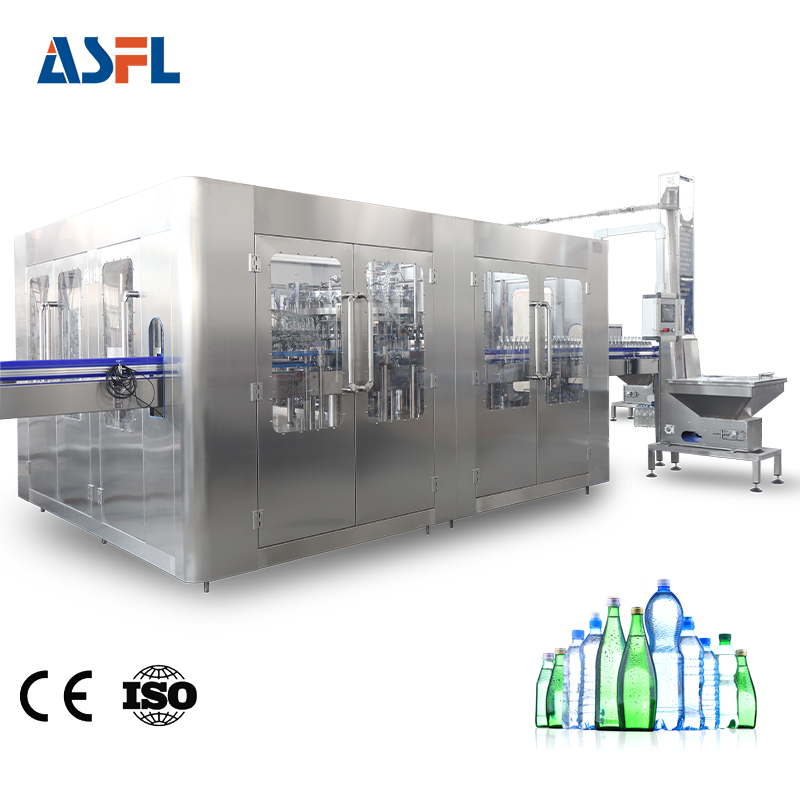
That distinction matters. A bottle mineral water filling machine can run at its intended mechanical speed while upstream water conditions need attention. When quality information is disconnected from line status, teams may discover a concern only during later sampling, review, or customer feedback. A properly designed monitoring module helps connect process quality to the actual production timeline.
Continuous indication is different from final release testing
Water-safety guidance and bottled-water quality controls emphasize sampling, analysis, sanitation, and records. Inline monitoring should support that system rather than be presented as a substitute for it. A sensor reading may indicate that a process variable has changed; it does not by itself establish microbiological status, regulatory conformance, or finished-product release.
The most defensible arrangement uses layers of control:
- Continuous process indication: online instruments watch selected variables and send a signal when a defined operating limit is crossed.
- Operator response: the line follows a documented action, such as checking the treatment skid, taking a confirmatory sample, placing affected lots on hold, or reviewing the last acceptable reading.
- Verification testing: scheduled laboratory or onsite analysis verifies the parameters that cannot be established by an inline device.
- Records and review: time-stamped trends, alarms, maintenance work, calibration results, and lot information make the event traceable.
In other words, the module improves response time and process evidence. It should be configured around a validated monitoring plan, not around an assumption that a dashboard alone proves water quality.
Where to install monitoring points
The location of a sensor determines what its reading means. A single point at the filler inlet can be useful, but it may not distinguish a source-water change from a treatment issue or a downstream distribution issue. For this reason, a mineral water filling line is commonly assessed as a sequence of checkpoints rather than as one isolated machine.
| Process point | What it can help indicate | Engineering question |
|---|---|---|
| Source or raw-water inlet | Incoming-water variation | Which baseline is normal for the source? |
| After key treatment stages | Stage performance or regeneration effects | Which parameter reflects the function of this stage? |
| Product-water storage or loop | Condition before filling | How are circulation, cleaning, and stagnant sections controlled? |
| At the filler supply point | What reaches the filling zone | How is the reading tied to line state and lot identification? |
Not every project needs every point. The choice depends on the treatment design, buffer capacity, source consistency, and the risk assessment. More accurately, the aim is to place measurements where they help isolate a change and trigger a useful action. Adding sensors without an alarm response plan can create data without control.
Make alarms actionable, not merely visible
A reliable mineral water filling line needs agreed meanings for normal, alert, and action conditions. During design review, define the expected operating range, alarm thresholds, alarm delay, escalation contact, and the exact line response. A momentary disturbance may require a warning and a check; a sustained excursion may require product hold and confirmatory testing. Those choices should follow the facility's hazard assessment and applicable local requirements.
Also separate instrument alarms from process alarms. Low sample flow, an expired calibration interval, or a dirty sensor can make a value unreliable even when the water process is stable. The operator display should show that difference clearly. Otherwise, operators may either overreact to maintenance conditions or ignore a genuine process signal.
For a bottle mineral water filling machine, the most useful alarm event is one that can be reviewed alongside filler start/stop state, CIP or sanitation status, tank level, valve status, and production lot. Time synchronization is a small design detail with large practical value when an investigation begins.
Design details that protect measurement quality
Inline readings are only as dependable as the installation and maintenance plan. Sample lines, flow cells, insertion points, temperature compensation, drainability, cleaning access, and sensor calibration all affect the result. The line supplier, water-treatment team, quality team, and plant maintenance team should agree on these connection points before final acceptance.
It is also useful to define a calibration and verification routine before startup. Specify reference methods, acceptance tolerances, frequency, responsibility, and the record format. If the probe is removed for cleaning or verification, the team should know how the mineral water filling line will operate during that interval and how the missing signal will be documented.
This is where the discussion moves from a feature list to a verification checklist. Rather than asking only for a monitor, request the process and electrical connection details, data tags, alarm matrix, cleaning method, calibration access, and factory or site test criteria. Target throughput should be tested with normal water-handling conditions in place, not treated as separate from quality control.
A practical specification checklist
- Define the water source, treatment stages, and product-water path.
- List the quality indicators that are useful for operational detection and identify which ones still require laboratory verification.
- Select each monitoring point based on the decision it will support.
- Document setpoints, alarm delay, product-hold logic, and investigation ownership.
- Specify hygienic installation, cleaning compatibility, sample flow conditions, and calibration access.
- Connect time-stamped readings to line state and lot records where the site's control system permits it.
- Test alarms, response procedures, and recovery conditions during commissioning.
Why the investment is a control decision
For a mineral water filling line, an inline water quality monitoring module is most valuable when it is part of a wider operating discipline: risk assessment, treatment control, sanitation, sampling, verification, and traceable response. It can shorten the time between a process change and an informed decision, while giving engineering and quality teams a shared view of what occurred.
Before purchasing a bottle mineral water filling machine or expanding an existing line, ask the supplier and internal quality team to review the monitoring architecture together. Confirm which variables matter, where they will be measured, what will happen at an alarm, and how results will be verified. That conversation produces a more useful specification than adding an instrument after the line has already been built.

 Hot News








