 EN

Hygienic Scope and Purified Water Bottling Technical Requirements
Establishing precise water bottle filling system technical requirements is mandatory for engineering a compliant, high-efficiency purified water processing facility. Purified drinking water lacks chemical preservatives, which means the bottling stage represents the single most vulnerable step for microbial re-contamination. Meeting international regulatory standards set by FDA Title 21 CFR 129, IBWA, and ISO 22000 requires zero compromise on fluid contact metallurgy, environmental air filtration, dynamic sealing chemistry, and automated CIP sanitization pathways.
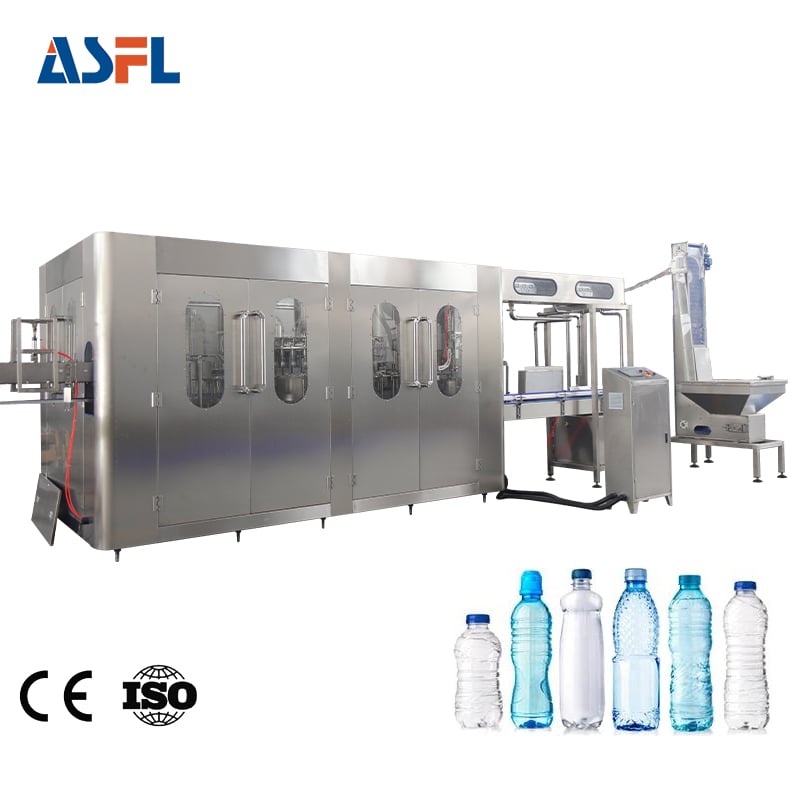
Comprehensive purified water filling system specs mandate an integrated monoblock architecture where bottle rinsing, volumetric filling, and cap application occur within a continuous ultra-clean enclosure. Evaluating these core purified water bottle filling standards ensures that engineering teams prevent bacterial growth, eliminate ozone degradation, and achieve high volume accuracy across high-speed packaging runs. Advanced equipment designs manufactured by ACE-FILLING integrate these stringent sanitary water bottling line requirements directly into the structural frame, establishing a stable foundation for long-term operational uptime and total commercial product safety.
Cleanroom Isolation and Class 100 HEPA Air Hygiene Architecture
The surrounding atmosphere inside a packaging hall contains airborne dust, spores, and bacteria. Adhering to strict water bottle filling system technical requirements demands isolating the filling and capping turrets inside a dedicated Class 100 (ISO Class 5) laminar flow cleanroom enclosure.
-
Positive Differential Air Pressure: HEPA air filtration units mounted on top of the filling canopy maintain a continuous positive pressure barrier above 15 Pascals. This positive pressure prevents ambient factory air from entering the sterile filling space when bottle entry doors open.
-
Class 100 HEPA Filter Performance: High-efficiency particulate air filters trap 99.97% of airborne particles larger than or equal to 0.3 micrometers, fulfilling fundamental purified water filling system specs.
-
Sloped Stainless Enclosure Top: Canopy ceilings feature sloped AISI 304 stainless steel construction to prevent condensation droplets from accumulating and dripping into open bottle necks.
-
Sterile Air Curtain Barriers: Infeed and outfeed bottle conveyors utilize high-velocity sterile air curtains to seal container entry points without impeding physical container transfer.
The following engineering matrix details the core technical standards required to comply with modern purified water bottle filling standards:
| Subsystem Component | Technical Material & Engineering Standard | Impact on Sanitary Water Bottling Line Requirements |
| Liquid Contact Surfaces | Solid AISI 316L Stainless Steel (Ra <= 0.4 micrometers) | Prevents pitting corrosion, biofilm adhesion, and chemical scale accumulation |
| Environmental Air Canopy | Class 100 (ISO Class 5) HEPA Laminar Flow Canopy | Eliminates airborne spores and dust to meet water bottle filling system technical requirements |
| Dynamic Valve Seals | FDA 21 CFR 177.2600 Compliant EPDM / PTFE | Resists degradation from hot ozonated water and 85°C CIP caustic washes |
| Bottle Rinsing Manifold | Dual-Stage Ozonated Water & Pure Air Purge | Achieves complete 3-log microbial reduction inside bottle preforms prior to liquid filling |
| Non-Contact Filling Valves | Magnetic Flow Meter or Electro-Pneumatic Gravity Valves | Eliminates mechanical contact between valve nozzle and bottle rim, reinforcing purified water filling system specs |
Metallurgy, Surface Roughness, and Sanitary Piping Standards
Material selection directly governs liquid purity and dynamic machine longevity. Standard commercial stainless steel grade 304 is acceptable for non-contact structural frames, but strict water bottle filling system technical requirements demand that all liquid-contact components utilize solid AISI 316L stainless steel.
Contact channels—including the main liquid balance bowl, fluid manifold pipes, and internal valve bodies—undergo high-precision mechanical polishing and electro-polishing to achieve a surface roughness Ra value less than or equal to 0.4 micrometers. This ultra-smooth surface profile eliminates micro-crevices where bacteria and algae can lodge. Furthermore, complying with sanitary water bottling line requirements dictates using zero-dead-leg Tri-Clamp fittings certified under ISO 2852 and DIN 11851 standards. Eliminating threaded pipe joints prevents stagnant liquid pockets, ensuring that automated Clean-in-Place (CIP) solutions flush all internal pathways cleanly.
Non-Contact Filling Valve Technology and Volumetric Accuracy
Achieving consistent fill heights without physical contact between the bottle neck and the filling valve is a core element of modern purified water bottle filling standards. Traditional gravity valves relied on the bottle mouth pressing against a rubber seal to actuate fluid flow. This physical contact creates high risks of cross-contamination if a dirty bottle mouth enters the machine.
Advanced purified water filling system specs incorporate non-contact electro-pneumatic or magnetic flow meter valves. The valve suspended above the bottle opens electronically without touching the container rim, guaranteeing absolute sterility.
-
High-Precision Flow Meter Calibration: Electromagnetic flow meters measure liquid volume dynamically, maintaining fill accuracy within a standard deviation of +/- 0.2%.
-
Dual-Speed Flow Control: High-speed initial flow followed by a slow-speed neck-finishing phase prevents liquid splashing, turbulence, and volume variances.
-
Drip-Free Shut-Off Nozzles: Spring-loaded ceramic valve tips seal instantly upon signal termination, preventing residual liquid droplets from falling onto bottle shoulders.
-
Automated CIP Dummy Cups: Pneumatic fake cups seal filling nozzles automatically during sanitization cycles, creating a closed loop that circulates hot caustic wash at 85 degrees Celsius to fulfill all water bottle filling system technical requirements.
Quality Verification and Factory Testing Protocols
To guarantee full compliance with global sanitary water bottling line requirements, ACE-FILLING subjects every purified water packaging system to comprehensive Factory Acceptance Testing (FAT) prior to shipment.
-
Hydrostatic Manifold Testing: All product storage bowls and fluid manifolds undergo 4-hour pressure testing at 1.5 times the maximum rated working pressure to verify weld integrity.
-
HEPA Air Laminar Flow Velocity Audits: Thermal anemometers measure air velocity across the Class 100 canopy ceiling, confirming uniform downward airflow between 0.36 and 0.54 meters per second.
-
Microbiological Challenge Verification: Test bottles inoculated with benign bacterial indicators undergo full rinsing, filling, and capping cycles to confirm zero CFU recovery.
-
Continuous 24-Hour Trial Run: Complete filler monoblocks undergo continuous 24-hour dry testing at full operating speed to confirm electrical stability, bearing temperature limits, and mechanical noise levels below 75 decibels.
Project engineers and beverage plant managers seeking compliant, high-efficiency packaging machinery can inspect complete technical specifications and customized line options at the official





 Hot News








