 EN

For a beverage plant, secondary packaging is not only a purchasing item. Film, trays, pads, and rejected packs become a recurring operating cost. An automatic bottle packing machine can lower avoidable material use when it creates repeatable bottle groups, controls the package dimensions, and keeps the wrapping cycle stable. The important distinction is between using less material per accepted pack and simply reducing a material setting until packs become unstable.
From a packaging-line engineering perspective, start with the bottle, the required pack pattern, and the actual production rhythm. Then review the packaging format. This order matters because an automatic bottle packing machine works with the geometry it receives; it cannot correct a poor bottle grouping or irregular incoming flow with a thinner film setting alone.
Where packaging material is lost on a beverage line
Material consumption usually rises in small increments that are easy to miss during a busy shift. Overlap that is wider than the designed seal zone, long film tails, off-center packs, torn film, and rejected bundles all consume material. An automatic bottle packing machine gives the plant a controlled point at which those losses can be measured and adjusted.
- Oversized packs: inconsistent bottle spacing or a loose collation can require more film or board than the intended pack footprint.
- Film-handling losses: poor tension, tracking, or registration can create wrinkles, breaks, and discarded web sections.
- Restart losses: after a jam or changeover, unverified settings can produce several unsuitable packs before the line stabilizes.
- Damage-related waste: a weak or uneven bundle may be rejected later, taking its packaging material with it.
The purpose of an automatic bottle packing machine is not to make a universal material-reduction claim. Its value is repeatability: it makes the relationship between pack configuration, material settings, and accepted output visible enough to manage.
1. Consistent bottle collation reduces unnecessary pack allowance
Before wrapping or case packing, bottles must reach the packer in a stable pattern. Guides, accumulation control, and timed transfer help form consistent rows and columns. When every group has the same length, width, and height, an automatic bottle packing machine can apply a repeatable material cut length rather than allowing for the largest irregular group.
This is particularly relevant for PET water and soft-drink multipacks, where a few millimeters of variation across several bottles can affect film overlap. The automatic water bottle packing machine configuration should be checked with the real bottle shape, cap profile, and label condition, rather than with empty-line assumptions. A stable pack footprint gives process engineers a credible starting point for trials with a narrower web, a revised cut length, or a different pack pattern.
2. Controlled film tension and registration limit trim and rejected web
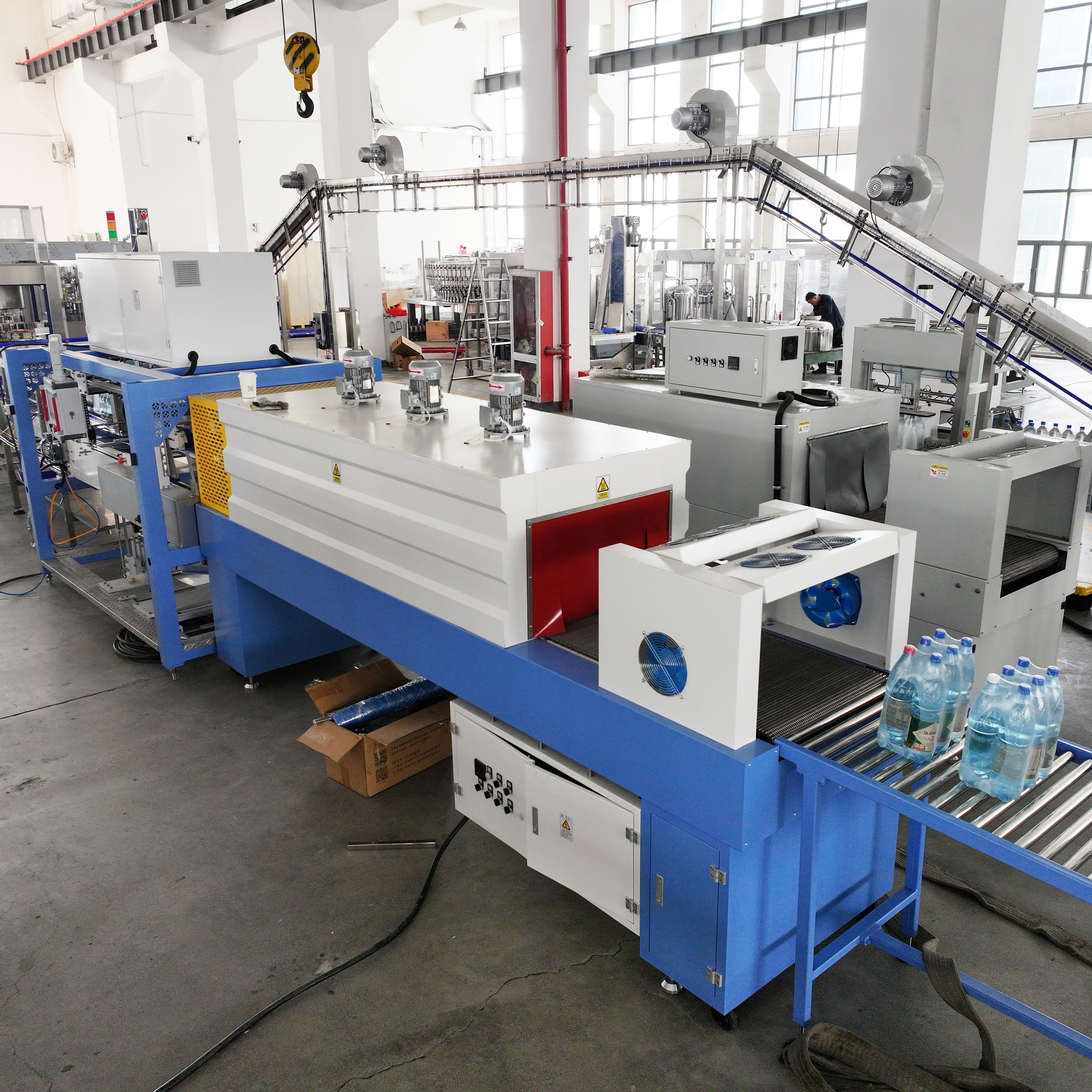
Film should travel through the machine with enough control to form a clean pack but without excessive stretch, slack, or lateral drift. In an automatic bottle packing machine, roller alignment, tension settings, sensing, and cutting registration work together. If the film snaps, wrinkles, or moves out of the intended position, the immediate loss is not only downtime; it is also the material removed during correction and the packs rejected around that event.
A useful operating check is to record film breaks, mis-cuts, and first-pass reject packs by shift. Do not rely only on film roll usage. A line may issue less film in one week while producing more damaged bundles, which moves the cost elsewhere. The automatic bottle packing machine should be tuned against accepted-pack results, including seal appearance, bottle containment, and handling performance.
3. Recipe control makes changeovers less material-intensive
Beverage plants often run several bottle sizes, pack counts, and label formats. Manual resets can leave former settings in place: guide widths, cut length, conveyor speed, or film parameters may not match the next SKU. An automatic bottle packing machine with documented recipes allows operators to return to validated settings and then make controlled adjustments only where the new bottle or pack requires them.
For each recipe, document the pack pattern, material type, nominal cut length, tension setting, operating speed, and acceptance criteria. During startup, separate commissioning scrap from normal production consumption. This gives the plant a more useful view of whether the automatic bottle packing machine is reducing setup-related waste over time.
4. Sensor feedback helps stop waste from accumulating
A photoelectric sensor, bottle-count check, film-mark sensor, or jam signal does not reduce material by itself. Its practical role is to detect a condition early enough for the system or operator to intervene before a run of unsuitable packs is produced. In an automatic bottle packing machine, this feedback can support controlled spacing, cut accuracy, and safer restart sequences.
For example, if a bottle group is incomplete, packaging it may create a bundle that does not pass later inspection. Removing it before material application may use less material, but the plant should also trace the cause upstream. The goal is not to move rejects around the line. The goal is to reduce the conditions that create them while maintaining a reliable package.
Measure material use per accepted pack
The most practical KPI is material issued divided by accepted packs, reported separately for each SKU and pack format. Track film kilograms or meters, trays or pads consumed, startup scrap, rejected packs, and rework. Review this data after an automatic bottle packing machine change, a new bottle, or a material specification revision.
| Measure | Why it matters | Review question |
|---|---|---|
| Material per accepted pack | Shows the usable material cost for the format | Did consumption change after allowing for output mix? |
| Startup scrap | Separates changeover losses from steady-state use | Which setting requires the most adjustment? |
| Film breaks or mis-cuts | Reveals handling instability | Are events linked to speed, roll change, or alignment? |
| Downstream pack rejects | Checks whether lower material use still supports handling | Did containment or transport issues increase? |
An illustrative calculation can help frame a trial: reducing film width from 12 inches to 11 inches represents about 8.3% less width, while one industry guide estimates a 4.2% material-cost change under its stated conditions. Actual results depend on film gauge, overlap, pack geometry, and validation results. An automatic bottle packing machine makes such trials repeatable; it does not make the calculation transferable to every plant.
Material reduction needs a pack-performance boundary
Less material is not automatically better. A beverage multipack still needs to retain its shape through transfer, palletizing, storage, and distribution. Before releasing a new setting, evaluate pack alignment, seal condition, bottle movement, handling damage, and rejection rate at the intended operating speed. The automatic bottle packing machine should run at production conditions during this check, not only at a reduced demonstration speed.
A practical sequence is to establish the current accepted-pack baseline, adjust one variable, run a defined sample, inspect the packages, and compare the KPI values. Change one variable at a time when possible. This approach helps a plant identify whether savings come from a smaller cut length, fewer restarts, better collation, or a revised pack design.
Questions to ask before specifying the machine
- Which bottle diameters, heights, and pack counts must the automatic bottle packing machine handle?
- What secondary-packaging material is used today, and what scrap categories are recorded?
- How are bottle groups formed before they enter the packer?
- Which recipe changes are frequent enough to justify documented settings?
- What pack tests define acceptable containment after material settings change?
Conclusion
An automatic bottle packing machine can support lower packaging-material consumption by making pack formation, film handling, cutting, and changeovers more repeatable. The strongest improvements come from a controlled baseline and a clear acceptance boundary, not from reducing material without verification. For a beverage plant, that means tracking material per accepted pack, investigating waste events, and validating each change against real production and handling conditions.

 Hot News








