EN

For craft breweries and industrial beverage plants alike, maintaining sensory integrity during high-speed packaging is the ultimate engineering challenge. Dissolved carbon dioxide (CO2) gives beer its characteristic crisp mouthfeel, aromatic hop release, and dense foam head. However, standard gravity or ambient atmospheric filling techniques subject carbonated beverages to sudden pressure drops, causing rapid off-gassing, excessive turbulence, and detrimental oxygen pickup.
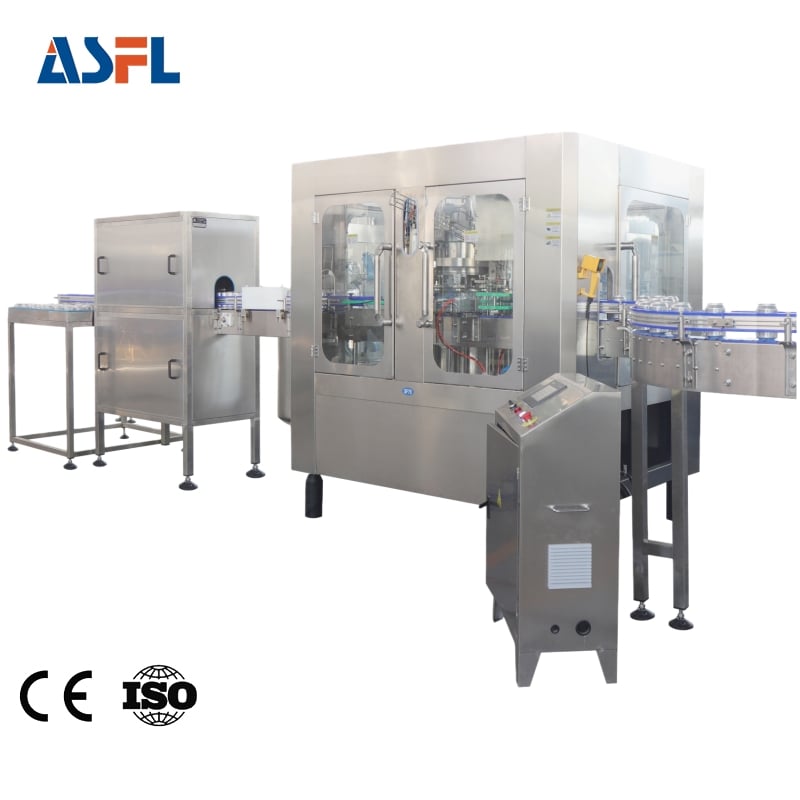
To overcome these physical limitations, professional breweries rely on an advanced counter pressure beer bottle filler. Engineered by industry specialists like ACE-FILLING, an automated isobaric beer bottling machine establishes equal pressure between the storage tank and the bottle prior to liquid dispensing. This dedicated technical guide breaks down the physical fluid dynamics, double-evacuation purging cycles, and mechanical valve designs that ensure a modern counter pressure filling machine effectively protects beer flavor and head retention from micro-brewery operations up to high-speed commercial packaging facilities.
The Chemical Physics of Beer Degradation During Bottling
Understanding why specialized isobaric technology is mandatory requires analyzing the two primary factors that ruin beer quality: oxidation and premature decarbonation.
-
Dissolved Oxygen (DO) Pickup: When beer contacts atmospheric air containing oxygen, sensitive hop alpha-acids and delicate ester compounds rapidly oxidize. This unwanted reaction produces trans-2-nonenal, a chemical compound responsible for stale, cardboard-like off-flavors, while severely diminishing fresh hop aroma.
-
Loss of Carbonation and Foam Dissolution: According to Henry's Law, the solubility of CO2 in a liquid is proportional to the partial pressure of that gas above the liquid. In an open filling system, the sudden drop to atmospheric pressure causes dissolved gas to flash out of solution rapidly, stripping volatile aromatic compounds and creating uncontrolled foam that ruins head stability.
Mechanism 1: Double CO2 Evacuation and Purging Cycles
To achieve minimum dissolved oxygen pickup, a high-performance counter pressure beer bottle filler executes a rigorous multi-stage purging routine before any liquid transfer begins.
-
Initial Vacuum Evacuation: A mechanical vacuum pump pulls atmospheric air out of the sealed bottle cavity, removing up to 90 percent of ambient oxygen.
-
First CO2 Pressurization: Pure food-grade CO2 gas is injected into the container to flush out lingering oxygen molecules.
-
Secondary Vacuum and Final CO2 Charge: A second vacuum cycle evacuates the mixed gas, followed by a final CO2 pressurization until the bottle internal pressure perfectly matches the main isobaric surge tank pressure (typically between 0.15 MPa and 0.25 MPa).
By replacing oxygen with an inert CO2 cushion, this automated routine ensures that a modern counter pressure filling machine completely protects beer flavor and head retention during liquid admission.
Mechanism 2: Isobaric Gravity Filling and Fluid Dynamics
Once internal pressure equilibrium is achieved, the filling valve opens mechanically or pneumatically. Because the pressure inside the bottle matches the pressure inside the filler bowl, liquid flows smoothly down the interior container walls driven purely by static gravity height differential.
-
Laminar Wall-Flow Nozzle Design: ACE-FILLING equips each filling valve with an umbrella-shaped spreader nozzle. This design directs beer smoothly along the inner glass walls rather than splashing into the bottom, preventing mechanical shear stress that causes foam collapse.
-
Gas Return Channel Management: As beer enters the vessel, the displaced CO2 gas escapes smoothly back into the top space of the pressure vessel through an isolated return pipe, preventing air turbulence and maintaining equilibrium. This continuous pressure balancing explains how an isobaric beer bottling machine consistently protects beer flavor and head retention.
Mechanism 3: Controlled Snifting and Cap-on-Foam Sealing
The transition from filling to capping requires delicate pneumatic control to seal the bottle before ambient exposure can occur.
-
Micro-Snifting Pressure Release: Once the targeted fill height is met, the gas return valve closes. A slow-release vent valve (snift valve) gradually vents residual top-space gas to equalize the head space with atmospheric pressure, preventing rapid expansion and uncontrolled foam eruption.
-
Controlled Foaming for Oxygen Displacement: Just prior to crown cap application, a sterile hot-water jet (jetting device) triggers a precise, controlled foam rise (fobbing). This localized foam layer completely pushes remaining gas out of the bottle neck, allowing crown placement over pure foam. This final step in the counter pressure beer bottle filler process ensures total packaged oxygen (TPO) levels remain well below 30 ppb.
Comparative Performance Metrics: Atmospheric vs. Isobaric Filling
To evaluate how isobaric mechanics preserve product quality, the comparison matrix below highlights operational parameters between traditional atmospheric fillers and an advanced isobaric beer bottling machine.
| Processing Parameter | Standard Atmospheric Gravity Filler | ACE-FILLING Isobaric Counter Pressure Line |
| Dissolved Oxygen (DO) Pickup | High (> 100 - 150 ppb TPO) | Ultra-Low (< 20 - 30 ppb TPO) |
| CO2 Loss During Transfer | Severe carbonation loss & flashing | Zero CO2 loss; retains original carbonation level |
| Head Foam Stability | Weak (Foam proteins broken by shear) | Superior (Protects hydrophobic foam proteins) |
| Filling Speed Efficiency | Slow (Delayed by unmanaged foaming) | High-Speed Continuous Isobaric Stream |
| Process Control Method | Manual mechanical Float Valves | Automated PLC-Controlled Isobaric Valves |
Quality Audit and Maintenance for Isobaric Bottling Lines
To sustain long-term performance and maintain rigorous food safety standards, plant engineers operating a counter pressure filling machine must follow precise maintenance routines:
-
Daily CIP/SIP Sterilization: Perform Clean-In-Place (CIP) hot-lye washing followed by Sterilize-In-Place (SIP) steam cycles up to 85C to destroy wild yeasts, lactic acid bacteria, and biofilm deposits across all fluid contact paths.
-
Vacuum Seal and O-Ring Inspections: Regularly check pneumatic seals, vacuum cup gaskets, and snift valves for wear to prevent vacuum leaks during double-evacuation stages.
-
Pressure Sensor Recalibration: Calibrate digital pressure transducers weekly to ensure accurate pressure matching between the filler bowl and bottles, guaranteeing that the counter pressure beer bottle filler consistently protects beer flavor and head retention.
Investing in a state-of-the-art counter pressure beer bottle filler is indispensable for breweries committed to delivering pristine flavor and head retention to end consumers. By utilizing double CO2 evacuation, smooth laminar filling, and precise fobbing control, an advanced isobaric beer bottling machine ensures uncompromised shelf life and sensory quality. Partnering with technology leaders like ACE-FILLING provides access to high-precision equipment where every counter pressure filling machine effectively protects beer flavor and head retention. Discover complete beverage packaging solutions at
 Hot News