 EN

The global carbonated soft drink sector is experiencing a major transformation driven by shifting environmental regulations, supply chain economics, and evolving consumer packaging preferences. Beverage brands are rapidly pivoting away from single-use plastic bottles toward infinitely recyclable metal containers. This industry-wide transition has created unprecedented global demand for high-speed, specialized aluminum can filling machine platforms. Unlike rigid glass bottles or semi-flexible PET containers, thin-gauge aluminum cans present unique structural and pressurization challenges that require advanced mechanical seaming and Isobaric pressure-filling controls.
As a pioneer in automated liquid packaging engineering,
Infinite Recyclability and Supply Chain Freight Efficiency
The most prominent driver behind the growth of the aluminum can filling machine market is the global push toward sustainable packaging and closed-loop circular economies.
-
High Recycling Rates and Infinite Circularity: Aluminum can be recycled repeatedly without degradation of material properties. Over 75% of all aluminum ever produced remains in active use today, making metal cans the primary choice for soft drink brands striving to meet ESG compliance and carbon-neutrality benchmarks.
-
Lightweight Logistics and Cube Efficiency: Aluminum cans offer superior pack density compared to glass or PET bottles. Their uniform cylindrical geometry eliminates dead air space inside shipping cartons, allowing distributors to fit up to 40% more liquid volume per freight pallet and significantly lowering transport fuel costs.
-
Rapid Thermal Conductivity: Metal cans cool much faster in refrigerated retail displays, providing superior consumer convenience for instant beverage consumption.
Isobaric Counter-Pressure Dosing and Double-Seam Mechanics
Packaging carbonated soft drinks requires maintaining precise carbon dioxide (CO2) dissolution levels (typically 3.0 to 4.5 volumes of CO2) throughout the filling cycle to prevent excessive foaming, product loss, or carbonation decay.
Isobaric Equalization and Valve Operation
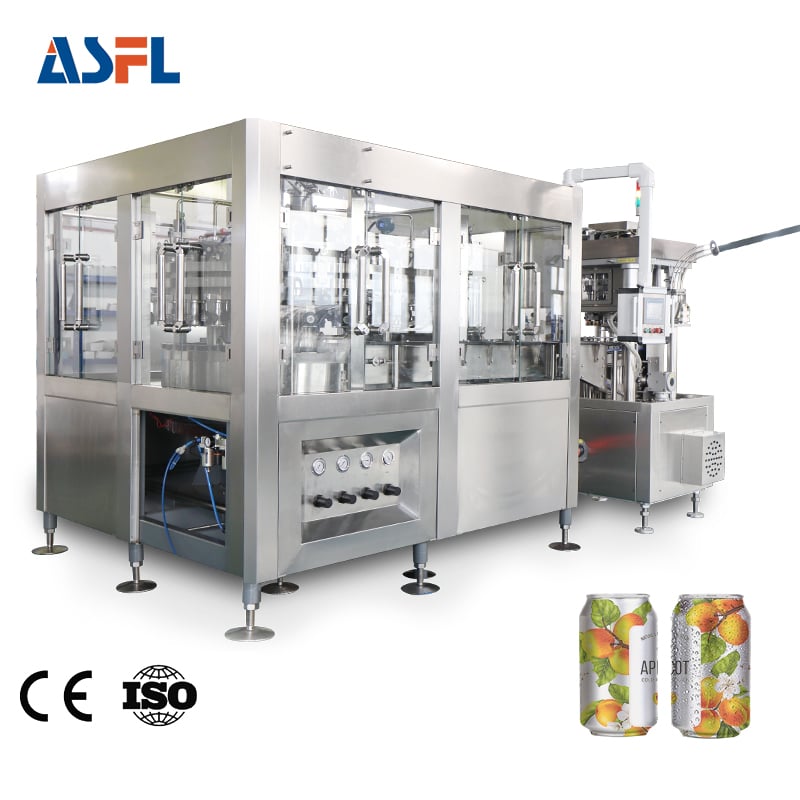
An advanced aluminum can filling machine employs Isobaric counter-pressure filling valves. Before liquid enters, the valve purges the empty can with CO2 gas and pressurizes the interior to match the tank equilibrium pressure. Liquid then flows smoothly down the interior can wall under gravity without CO2 breakout or foaming, guaranteeing exact volumetric fills.
Double-Seaming Hermetic Integrity
Because aluminum cans lack threaded closures, securing an airtight seal relies on mechanical double-seaming. High-precision seaming turrets fold the can lid hook and body flange together in two distinct rolling operations (First Operation Seam and Second Operation Seam). This creates a gas-tight, pressure-resistant seal capable of withstanding internal carbonation expansion during high-temperature transport.
Equipment Comparison: PET Bottling Line vs. Aluminum Can Packaging Monoblock
Adapting a plant floor for aluminum cans requires fundamentally different dosing and sealing mechanics compared to plastic bottling suites. The table below compares technical parameters between a traditional PET bottling setup and a modern aluminum can filling machine.
| Operational Metric / Feature | PET Bottle Packaging Line | High-Speed Aluminum Can Filling Machine |
| Material Circularity Index | Moderate (Degrades over recycling cycles) | Infinite (100% infinitely recyclable aluminum) |
| Dosing Principle | Gravity / Flowmeter / Level filling | Isobaric counter-pressure equalized filling |
| Closure Sealing Mechanism | Threaded plastic screw / Snap cap | Mechanical double-seaming (1st & 2nd operation) |
| Freight Volume Efficiency | Moderate (Higher tare weight & air gap) | Superior (Maximized pallet pack density) |
| Light & Oxygen Barrier | Partial (UV light & gas permeability) | Absolute (100% UV light & oxygen barrier protection) |
| Dissolved CO2 Loss Rate | Moderate during neck filling phase | Ultra-Low (Inert CO2 under-cover gassing prior to seaming) |
Real-World Case Study: Production Modernization for Sparkling Beverages
To evaluate the operational impact of transitioning to metal canning, consider a regional soft drink brand scaling distribution across national retail chains.
-
The Challenge: The manufacturer relied on a legacy PET bottling line. Rising plastic taxes and retailer demands for eco-friendly packaging threatened their shelf space. Additionally, CO2 loss during PET bottling led to inconsistent fizzy taste profiles and a 3.4% product rejection rate.
-
The ACE-FILLING Solution: The producer installed an ACE-FILLING 24-head rotary aluminum can filling machine integrated with a 4-head mechanical double seamer and inline under-cover CO2 gassing.
-
The Outcome: The transition to aluminum cans boosted carbonation stability, locked CO2 levels to strict target specifications, and reduced product loss to less than 0.1%. Retail distribution grew by 120%, and the facility secured full ISO 22000 and BRCGS food safety compliance.
International Engineering Standards and Quality Assurance
Deploying high-speed canning equipment requires strict compliance with sanitary design frameworks and pressure vessel safety standards.
-
Sanitary SUS316L Metallurgy: All product-contact manifolds, filling valves, and gas lines inside an ACE-FILLING aluminum can filling machine are constructed from electro-polished SUS316L stainless steel, featuring smooth mirror-polished interiors (Ra < 0.4 um) that prevent microbial harboring.
-
Under-Cover CO2 Flushing: Before the seaming operation seals the lid onto the can body, a high-velocity jet of CO2 displaces any oxygen trapped inside the headspace, ensuring long-term flavor preservation and preventing beverage oxidation.
Conclusion
The growing demand for an aluminum can filling machine across the soft drink industry is driven by the undeniable advantages of metal packaging: infinite sustainability, superior freight efficiency, and absolute beverage freshness. By combining Isobaric counter-pressure filling with high-precision double seaming, modern canning suites enable beverage producers to meet aggressive eco-friendly packaging targets while expanding production capacity. To explore customized aluminum canning solutions for your plant floor, visit

 Hot News








