EN

A fruit juice filling machine is often discussed as if juice were one uniform liquid. In production, it is not. A clear drink, a nectar with fine pulp, and a fruit beverage with suspended pieces can move very differently through the same feed path. Thick edible oil adds another useful comparison: it may flow steadily, yet its resistance to movement can change the way a filler draws, meters, and discharges product. For these conditions, a piston-based dosing arrangement can be a practical option when its cylinder, valves, nozzle, and upstream supply are matched to the material.
From a liquid-filling selection perspective, start with the product rather than the nominal line speed. Viscosity, particle size, temperature at fill, foam tendency, and bottle geometry all affect whether a fruit juice filling machine will run consistently. The phrase piston liquid filling machine describes a metering principle, not a universal answer for every juice formula.
Why a piston system suits thicker products
A piston filler works by drawing a defined volume into a cylinder and then displacing that volume through a valve and nozzle. This positive-displacement action is useful when gravity alone does not provide a stable flow. With thick edible oil, the product may resist rapid movement but still pass through a suitably sized filling path. With fruit pulp juice, the concern expands beyond thickness: pulp can bridge at restrictions, settle in a hopper, or leave an uneven particle distribution between fills.
That is why a fruit juice filling machine needs to be evaluated as a flow system. The piston stroke establishes the nominal dose, but the result also depends on whether the supply remains available at the inlet and whether the outlet path allows the product to leave without excessive shear, splashing, or blockage. More accurately, a piston arrangement should be chosen after the liquid and container conditions are confirmed.
Thick edible oil: focus on draw-in and cutoff
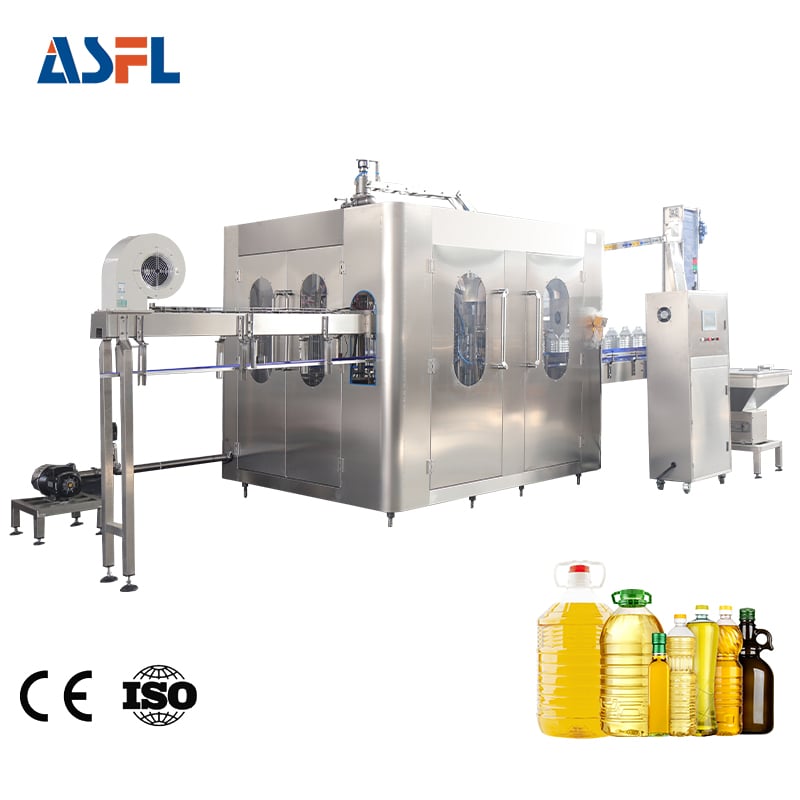
Edible oil with higher viscosity can place more demand on the suction side of the fill cycle. A hopper that is too small, an inlet that is too restrictive, or a rapid stroke can make draw-in less stable. The practical response is not simply to increase speed. Review the product temperature range, inlet diameter, piston-cylinder sizing, seal compatibility, and the time available for the cylinder to refill.
At the discharge end, the nozzle has to cut off cleanly enough for the selected bottle and fill level. A long, narrow nozzle passage may work for a thinner oil but become less suitable as resistance rises. In a fruit juice filling machine project, the same review applies to any thick liquid: observe the product at the actual fill temperature and verify the fill pattern in the intended container. A bench sample alone may not reproduce hopper head pressure or production dwell time.
Fruit pulp juice: design around particles, not only viscosity
Fruit pulp juice introduces a second variable: the solids must reach the filling valve in a repeatable way. A formula can look fluid in a vessel while still contain fibers or pieces that challenge a narrow valve seat. If the pulp fraction settles during a pause, the first and later bottles may differ in texture even if the piston stroke is unchanged.
For this reason, a piston liquid filling machine used for pulp-containing juice should be reviewed for passage geometry from hopper to nozzle. The supplier and processor should agree on the largest expected particle, the acceptable particle condition after transfer, and whether gentle agitation or recirculation is needed to maintain distribution. These choices need trials with the actual recipe; a theoretical capacity figure does not establish that pulp remains uniform.
- Use a product path with no unnecessary tight restrictions or abrupt diameter changes.
- Confirm that valves, seals, and nozzle bores accommodate the expected pulp and fiber characteristics.
- Check whether the feed vessel needs controlled agitation to limit settling during normal stops.
- Run consecutive-fill samples after startup and after a planned pause, then compare volume and product appearance.
Match the piston, valve, and nozzle as one dosing set
The cylinder volume and piston stroke determine the metered amount, but they cannot be specified in isolation. A larger passage can reduce restriction for thick liquid or pulp, while a valve design must still switch cleanly between draw-in and discharge. Nozzle selection affects bottle entry, drip behavior, and the way a product spreads at the bottom of the container. If liquid characteristics are relatively stable, this comparison becomes more meaningful; if they vary by batch or temperature, the trial plan should reflect that range.
For a fruit juice filling machine, ask for a demonstrated recipe window rather than assuming one setting covers clear juice, nectar, and pulp juice. The useful questions are: What fill volume is required? What is the minimum and maximum product temperature? What pulp size and concentration are expected? Which bottle neck and fill level are used? How long can the hopper sit before the product behavior changes? Answers to these questions convert a broad equipment request into a configuration discussion.
Feed stability can be the real bottleneck
It is tempting to judge a piston liquid filling machine only by the piston. In practice, an unstable feed can undermine an otherwise suitable dosing system. A thick oil may refill the cylinder slowly if the inlet path is undersized. Pulp juice may need a feed arrangement that keeps solids suspended without damaging the product. The filler, hopper, transfer pump, piping, and controls should therefore be reviewed together.
Shift the discussion from a single-machine parameter to the line interfaces. Confirm the available upstream pressure, the location of any filter or strainer, the container-handling rhythm, and the downstream capper timing. A fill nozzle that reaches the bottle correctly is still only one part of a stable packaging sequence. During trials, record conditions such as product temperature, hopper level, cycle rate, and changeover state so that the observed result can be repeated.
Cleanability matters when pulp and oil share the product path
Food-contact equipment should be reviewed for accessible, cleanable product surfaces and for locations where oil or fruit solids could remain after production. Guidance on hygienic design emphasizes smooth surfaces and the avoidance of crevices that retain residue. That does not establish a particular machine's compliance status; it sets a practical inspection point for the buyer.
For any fruit juice filling machine, ask how the cylinder, valves, seals, hoses, and nozzles are cleaned and inspected. Verify the cleaning method against the actual formulation, especially where pulp or viscous oil can collect. A documented cleaning procedure, compatible materials, and a validation plan provide a more useful basis for evaluation than a generic hygiene statement.
A trial-fill checklist before configuration is released
- Supply the actual edible oil or fruit pulp juice, including its expected temperature range and particle information.
- Test the intended bottle, neck finish, target volume, and capper timing.
- Observe a sequence of fills at normal production conditions, including restart after a pause.
- Inspect for dose consistency, splashing, drips, particle distribution, and visible product retention.
- Review the cleaning and changeover process before the final configuration is approved.
These checks help separate a promising concept from a configuration that suits the real process. They also support clearer communication between production, quality, and equipment teams.
Conclusion
A piston approach can give a fruit juice filling machine controlled volumetric dosing for thick edible oil and fruit pulp juice, provided the entire wet path is designed around the product. For oil, concentrate on inlet flow, piston refill, and nozzle cutoff. For pulp juice, add particle passage, distribution, and cleanability to the evaluation. The next step is to define the product and container conditions, then use a representative trial fill to confirm the piston, valve, nozzle, and feed arrangement together.
 Hot News