 EN

What Operational Limits Apply to an Automatic Barrel Filling Machine for a 20 Litre Water Can?
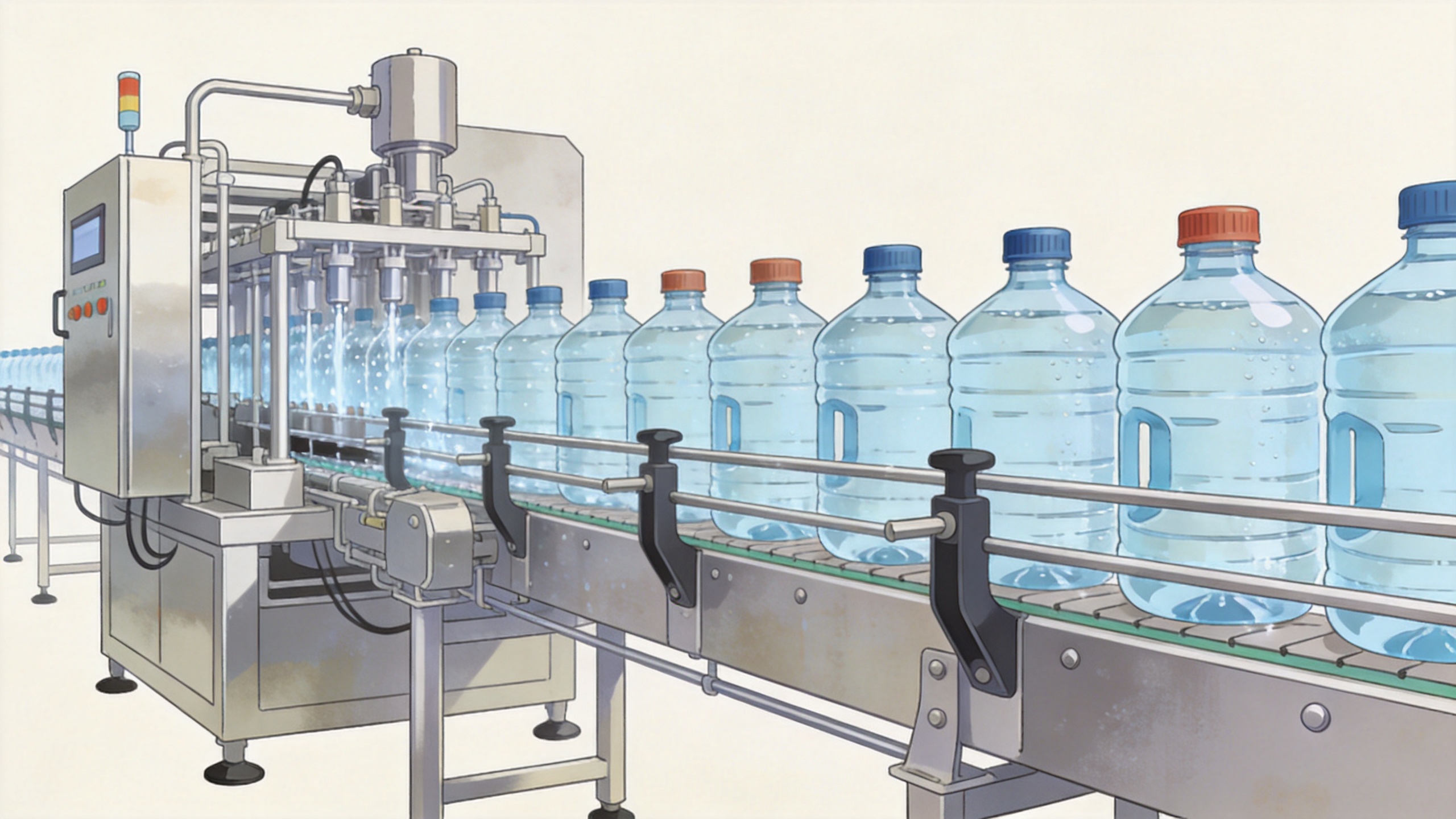
For a production-line engineer, a more useful question than “How fast can it fill?” is this: at what rate can it wash, fill, cap, inspect, and discharge returnable cans without compromising hygiene or creating a queue? A 20 litre water can filling machine is limited by the slowest verified part of that sequence. A headline barrels-per-hour figure can be technically true in a controlled trial and still be unsuitable for a normal shift with mixed can condition, sanitation routines, operators, and downstream handling.
Commercial systems are often marketed across a broad range of roughly 100 to 1,200 five-gallon or near-20-litre barrels per hour. Treat that as a planning range, not a promise. The sustainable rate of a 20 litre water can filling machine must be proven with your water treatment supply, actual returnable cans, caps, cleaning recipe, and packing flow in place.
1. Output is constrained by the full wash–fill–cap cycle
The rated filling-valve speed is only one component of the cycle. A 20 litre water can filling machine normally relies on loading, external or internal washing, draining, rinsing, sanitizing, filling, cap placement, capping, and discharge. If washing takes longer than filling, adding filling heads does not raise line output. If cap feeding pauses, filled cans accumulate. If the operator has to reject damaged barrels one at a time, the automatic section waits.
Ask the supplier for a cycle-time breakdown rather than a single capacity number. It should identify the assumed can format, number of wash stations, rinse and sanitize dwell time, fill time, cap-feeder replenishment interval, and buffer capacity. For a 20 litre water can filling machine, sustained output should be demonstrated over a representative run, not inferred from an empty-machine speed.
2. Returnable can condition sets a practical ceiling
A 20 litre water can filling machine is designed around a defined neck finish, height, diameter, handle geometry, base stability, and wall stiffness. Returnable cans that are deeply scratched, oval, heat-distorted, cracked, or contaminated may fail to seat correctly, wash consistently, or cap securely. The machine cannot compensate for every variation in a returned container fleet.
Before selecting a 20 litre water can filling machine, sort a sample of real incoming cans by condition. Measure the range of neck and body dimensions, record the rejection rate, and test the oldest containers—not just new reference samples. Decide whether you need manual pre-inspection, automatic rejection, or a stricter can-return policy. This is often the difference between a stable line and a line that repeatedly stops for small mechanical corrections.
3. Hygiene requirements limit how quickly the line can run
Sanitation is a production constraint, not an add-on. In the United States, 21 CFR Part 129 requires product-water contact surfaces used with multiservice containers, utensils, pipes, and equipment to be clean and adequately sanitized. It also requires reusable primary containers to be washed, rinsed, and sanitized by methods that give adequate sanitary results. Your local rules and customer standards may impose different or additional requirements, but the operational lesson is the same: a 20 litre water can filling machine needs enough wash, rinse, sanitize, drain, and verification time for the water and container program.
Do not shorten the cleaning sequence solely to meet a target rate. Confirm chemical compatibility, concentration control, contact time, rinse-water quality, drain performance, and validation records with the responsible quality team. A 20 litre water can filling machine may need to run below its nominal maximum when the sanitation program calls for longer dwell time or more frequent changeover cleaning.
4. Water supply and utilities can become the bottleneck
At 20 litres per accepted can, the treated-water system must deliver a stable flow at the required quality while also supporting flushing and other line demands. A 20 litre water can filling machine cannot maintain output if the product tank level falls, pressure fluctuates, or upstream treatment is regenerating. Product-water temperature and dissolved-gas conditions can also affect foaming and fill stability, depending on the process.
Review the entire utility balance: treated-water storage, pump curve, pressure regulation, compressed-air quality, electrical capacity, drain capacity, wash-water supply, and wastewater handling. In practice, the weakest utility during the busiest part of the shift often sets the line limit. Require the supplier to state the site services assumed for the validated rate.
5. Filling accuracy and overflow control require a stable process
Higher speed reduces the time available to settle liquid, control valves, and detect abnormal filling. For a 20 litre water can filling machine, unstable incoming pressure, foam, inconsistent can positioning, or worn seals can lead to underfill, overflow, wet caps, and rework. Raising the speed may therefore increase gross output while reducing accepted output.
Define the acceptance criteria before the factory acceptance test: target fill volume, allowed tolerance, reject method, test sample size, and the operating conditions used. Test a 20 litre water can filling machine with your intended cap and a realistic water condition. A practical target is the highest defensible rate at which fill accuracy, cap application, cleanliness, and reject rate remain within your specification.
6. Capping, inspection, and downstream handling must keep pace
A 20 litre water can filling machine stops being productive if the cap sorter, cap chute, torque station, date coder, leak check, or discharge conveyor cannot match it. Heavy filled cans also need stable transfer and enough accumulation space. A short conveyor can turn a minor downstream pause into an immediate stop at the filler.
Map the line from empty-can loading to palletizing or delivery staging. Count how many cans each buffer can hold and calculate how long that buffer protects the filler during a small interruption. For an automatic water filling machine, the most economical improvement may be a better cap-feeding arrangement or a longer accumulation conveyor—not a faster filler.
7. Changeovers and maintenance reduce available capacity
Nameplate capacity excludes planned sanitation, warm-up, routine inspection, cap replenishment, changeover, and maintenance. A 20 litre water can filling machine also needs accessible nozzles, valves, seals, sensors, and wash components so technicians can complete routine work without extended downtime. If the line uses more than one can or cap specification, every additional format adds setup controls and validation work.
Ask for an operating availability model. Start with scheduled production time, then subtract sanitation, planned maintenance, expected changeovers, and a realistic allowance for minor stops. The result is more useful than a peak-speed brochure value because it estimates saleable cans per shift.
A selection checklist for realistic capacity
- Specify the target 20 litre water can filling machine output as accepted cans per hour, not only theoretical cycles.
- Provide real samples of the oldest, most variable returnable cans and the intended caps.
- Document wash, rinse, sanitize, and drain requirements with the quality team.
- Verify treated-water flow, tank capacity, pressure, power, air, drains, and wastewater capacity at peak demand.
- Confirm fill tolerance, cap performance, rejection method, and acceptance-test duration.
- Check cap feeding, coding, inspection, conveyors, buffers, and staff handling as one connected line.
- Request accessible maintenance points, spare-parts recommendations, and an availability calculation.
Bottom line
The operational limit of a 20 litre water can filling machine is not fixed by filling heads alone. It is set by the slowest validated combination of can condition, sanitation dwell time, water and utility supply, filling stability, capping, downstream accumulation, and planned downtime. Select and accept the machine at the rate your complete line can sustain while meeting quality requirements. That approach gives a more dependable production plan than choosing the highest advertised barrels-per-hour figure.

 Hot News








