 EN

Technical Scope of 5 Gallon Bottling Line Validation Protocols
Executing a rigorous 5 gallon bottling line validation process is mandatory prior to releasing large-format water packaging equipment for commercial production. Because five-gallon polycarbonate and PET barrels are recycled repeatedly across municipal delivery networks, internal container contamination risks are vastly higher than single-serve bottle packaging. Establishing strict 5 gallon water filling validation criteria protects public health, ensures regulatory compliance with IBWA and FDA Title 21 CFR 129, and guarantees long-term operational profitability.
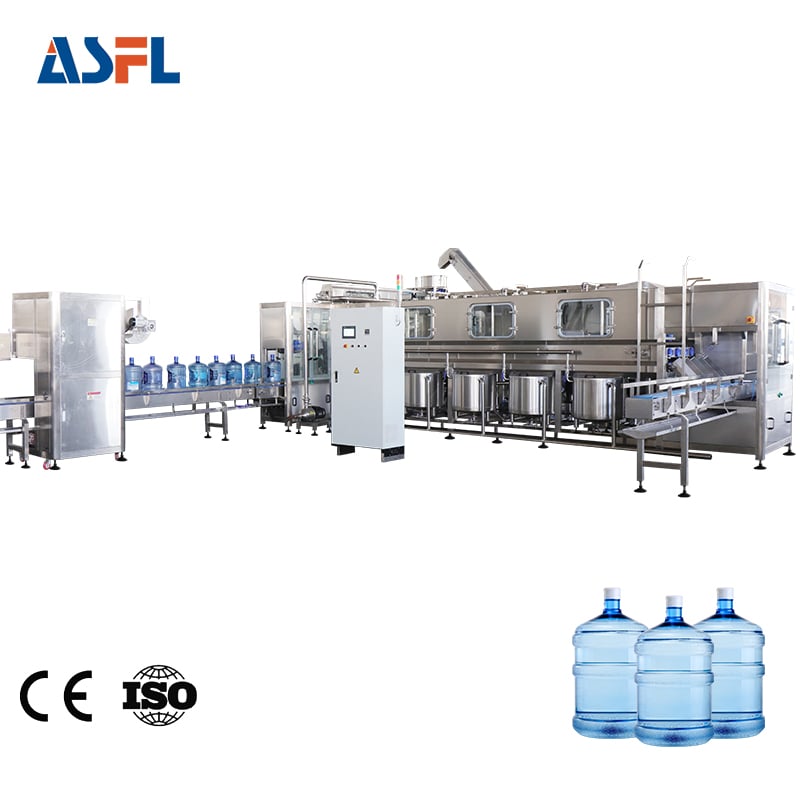
A complete commercial 5 gallon bottling line validation protocol encompasses Installation Qualification (IQ), Operational Qualification (OQ), and Performance Qualification (PQ). Modern automated lines manufactured by ACE-FILLING integrate multi-stage internal decapping, high-pressure washing, liquid filling, and automatic capping. Passing the 5 gallon water plant validation standard requires verifying mechanical positioning tolerances, thermal chemical sanitization boundaries, volumetric accuracy, and seal integrity. Skipping or shortening validation stages leads to micro-leaks, chemical wash carryover, bacterial contamination, and costly product recalls.
Multi-Stage Barrel Washer Sanitation and IQ/OQ Qualification
The washer section is the most critical subsystem during 5 gallon bottling line validation. Returned barrels carry physical debris, mineral scale, and microbial biofilms. The washer must execute sequential internal and external cleaning cycles using heated caustic solution, recycled rinse water, chemical disinfectant, and final product water spray.
During Installation Qualification, field technicians verify that all piping materials comply with AISI 316L stainless steel standards, pneumatic valves function properly, and electrical wiring meets international CE and UL codes. Operational Qualification verifies that spray nozzles deliver precise impact pressure without leaving blind spots inside the inverted barrel base.
-
Caustic Wash Temperature Verification: Temperature sensors must maintain alkali wash tanks between 55 and 65 degrees Celsius continuously throughout high-speed operational cycles.
-
Chemical Disinfectant Concentration Control: Automatic dosing pumps must maintain chlorine dioxide or peracetic acid concentrations within exact parts-per-million thresholds to satisfy 5 gallon water filling validation criteria.
-
Final Product Water Rinse Clearance: High-purity product water sprays must eliminate all residual sanitizing chemicals to prevent taste alterations or regulatory compliance failures.
-
Nozzle Centering and Pressure Checks: Spray nozzles must align concentric to the barrel neck, supplying liquid impact pressure between 0.3 and 0.4 MPa for thorough interior coverage.
The following qualification matrix outlines core parameter benchmarks necessary to pass a commercial 5 gallon bottling line validation audit:
| Validation Phase | Testing Parameter | Acceptance Criterion Benchmark | Operational Impact on 5 Gallon Water Plant Validation Standard |
| Installation Qualification (IQ) | Piping & Frame Material | AISI 316L contact parts & AISI 304 frame construction | Prevents structural pitting corrosion and maintains sanitary fluid channels |
| Operational Qualification (OQ) | Wash Pressure & Temperature | 0.35 MPa pressure at 60 degrees Celsius wash temperature | Ensures mechanical removal of internal biofilms during 5 gallon bottling line validation |
| Operational Qualification (OQ) | Chemical Residue Sweep | Zero detectable chemical residue in final rinse water | Complies with 5 gallon water filling validation criteria for chemical safety |
| Performance Qualification (PQ) | Volumetric Filling Accuracy | Standard deviation within +/- 0.5% across 100 consecutive barrels | Guarantees label volume compliance under commercial 5 gallon bottling line validation |
| Performance Qualification (PQ) | Microbiological Clearance | Zero CFU per 100 ml total coliforms & Pseudomonas aeruginosa | Achieves full compliance with international 5 gallon water plant validation standard requirements |
Liquid Filling Accuracy and Headspace Pressure Calibration
Passing the volumetric filling stage of 5 gallon bottling line validation requires extreme precision. Because five gallons represents a substantial mass (approximately 18.9 liters or 18.9 kilograms), minor percentage errors in filling volume cause significant yield losses over continuous shifts.
Filling mechanisms typically utilize non-contact flow meters or time-gravity filling valves mounted inside a Class 100 HEPA air isolation chamber. During commercial 5 gallon bottling line validation, test engineers run consecutive filling cycles at full operating speeds.
-
Drip-Free Valve Sealing: Filling nozzles must shut off cleanly without post-drip droplets that contaminate the exterior bottle shoulder.
-
Volume Variance Limits: Volumetric metering systems must maintain volume accuracy within +/- 0.5%, fulfilling strict 5 gallon water filling validation criteria.
-
Flow Velocity and Foaming Control: Liquid discharge velocities are calibrated using dual-speed filling profiles—fast initial flow followed by slow neck finishing—to eliminate liquid splashing and turbulence.
-
HEPA Air Laminar Flow Integrity: Differential pressure gauges across the Class 100 HEPA ceiling must maintain positive overpressure above 15 Pascals to prevent ambient airborne dust from entering open barrel necks.
Capping Seal Integrity and Microbiological Challenge Testing
The final phase of a 5 gallon bottling line validation audit tests automatic cap feeding, cap pressing, and final seal hermeticity. Five-gallon caps feature internal foam liners or integrated thermal seals that must press firmly over the bottle neck rim.
During Performance Qualification, test barrels are subjected to physical drop tests, side-pressure tilt tests, and vacuum leak inspections. A cap that slips or fails to seat completely allows ambient air ingress, destroying product shelf stability.
-
Pneumatic Press-on Force Alignment: Capping heads must apply uniform downward force to seat PE snap caps securely without cracking the bottle neck ring, satisfying 5 gallon water plant validation standard guidelines.
-
Cap Sterilization Tunnel Verification: Cap chutes must integrate ultraviolet radiation tunnels or ozone spray wash systems, achieving a 3-log microbial reduction before caps touch bottle rims.
-
Microbiological Swab Testing: Quality teams take surface swabs from internal bottle walls, capping chucks, and fill nozzles after a 72-hour continuous production trial. Test samples must prove zero colony-forming units for total coliforms, yeast, mold, and Pseudomonas aeruginosa.
-
Structural Stability and Line Speed OEE: The complete bottling system must operate continuously at nominal rated speed for 24 hours without mechanical jams, confirming overall commercial 5 gallon bottling line validation success.
Bottling line engineers and project developers can review complete machinery technical drawings and modular validation support options at the official

 Hot News








