 EN

Technical Foundations of Product Consistency in Bottled Water Packaging
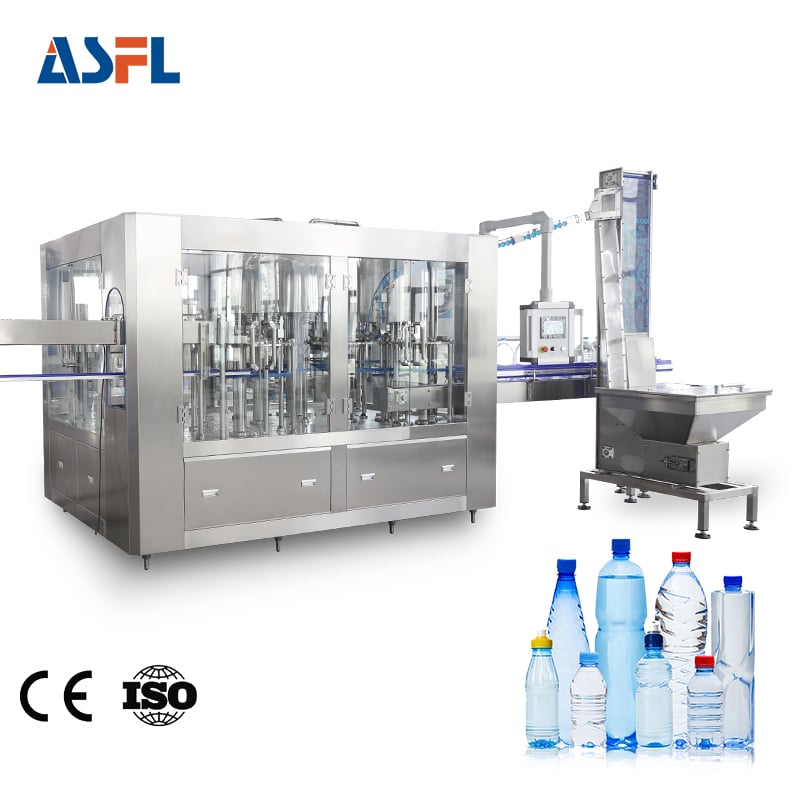
Achieving strict quality uniformities across large-scale commercial bottling operations requires a deep integration of automated liquid handling, closed-loop sensor telemetry, and precise mechanical alignment. Utilizing a fully automatic water bottle filling machine transforms bottled water manufacturing by eliminating human error, physical contact, and manual calibration variance during high-speed production runs. When beverage packaging plants rely on manual or semi-automated systems, minor operator fatigue, inconsistent valve closure times, and manual capping torque adjustments lead to varying liquid fill heights and compromised container seals.
Establishing robust water bottle filling product consistency relies on controlling volumetric fluid dispensation, neck handling stability, and environmental air filtration under standardized factory parameters. Advanced machinery engineered by ACE-FILLING implements electro-pneumatic flow valves, servo-driven capping heads, and Class 100 HEPA air enclosures to ensure that every single bottle leaving the conveyor meets identical aesthetic, volumetric, and hygienic standards. Evaluating how an automatic bottling line volume accuracy control loop functions reveals that automated packaging lines stabilize liquid meniscus heights, maintain exact seal torques, and uphold high bottled water packaging consistency across continuous multi-shift operations.
Electro-Pneumatic Volumetric Control and Flow Meter Metrology
The primary metric evaluating product uniformity in liquid packaging is volumetric accuracy across consecutive containers. A modern fully automatic water bottle filling machine replaces traditional spring-actuated mechanical gravity valves with non-contact electro-pneumatic valves or electromagnetic flow meters linked directly to programmable logic controllers (PLCs).
In legacy manual operations, fluid flow depends on physical bottle contact against valve seals, leading to volume variations caused by slight PET preform height tolerances or bottle neck deformation. By contrast, an automated monoblock achieves superior water bottle filling product consistency through precise digital timing or magnetic flow metering that meters water volume independently of container dimensions.
-
Non-Contact Fluid Nozzle Dispensing: Suspended liquid filling nozzles inject purified water into bottle necks without touching the container rim, preventing mechanical cross-contamination while stabilizing bottled water packaging consistency.
-
High-Frequency Electromagnetic Flow Sensors: Micro-pulse flow meters continuously measure fluid velocity and volume in real time, transmitting pulse signals to central PLCs to achieve automatic bottling line volume accuracy within a standard deviation of +/- 0.2 percent.
-
Dual-Speed Flow Modulation: Filling algorithms execute a fast-initial fill followed by a controlled slow-neck-finishing sequence, preventing liquid splashing, turbulence, and volume overshoot.
-
Closed-Loop Fluid Pressure Regulation: Overhead sanitary liquid bowls utilize pneumatic proportional valves and level transducers to maintain a constant static pressure head, ensuring uniform flow rates across all active filling spindles on a fully automatic water bottle filling machine.
The following engineering comparison highlights key parameters driving product uniformity between manual/semi-automatic filling systems and fully automated packaging monoblocks:
| Performance Criterion | Manual / Semi-Automatic Filling Line | Fully Automatic Water Bottle Filling Machine | Operational Impact on Product Consistency |
|---|---|---|---|
| Volumetric Filling Tolerance | Volumetric variance ranges between +/- 1.5% to +/- 3.0% | High-precision volumetric tolerance within +/- 0.2% | Guarantees automatic bottling line volume accuracy and net volume compliance |
| Capping Torque Uniformity | Variable torque applied by operator hand or basic pneumatic clutches | Servo-controlled dynamic torque chucks with hysteresis control | Ensures uniform cap seal tightness and consistent opening force |
| Environmental Air Hygiene | Exposed to ambient room dust, airborne yeast, and microbial spores | Enclosed Class 100 (ISO Class 5) HEPA positive-pressure canopy | Prevents bacterial contamination, elevating water bottle filling product consistency |
| Line Speed Stability | Fluctuates between 500 to 2,000 BPH based on operator speed | Continuous 6,000 to 36,000 BPH synchronized throughput | Eliminates process bottlenecks to maintain bottled water packaging consistency |
Servo-Driven Capping Torque Precision and Hermetic Seal Uniformity
Product consistency extends beyond liquid fill height; it demands consistent container capping integrity across every batch. If capping torque varies across production runs, consumers encounter bottles that are difficult to open, while under-torqued caps result in micro-leaks, carbonation loss (in carbonated lines), or oxygen ingress during transportation.
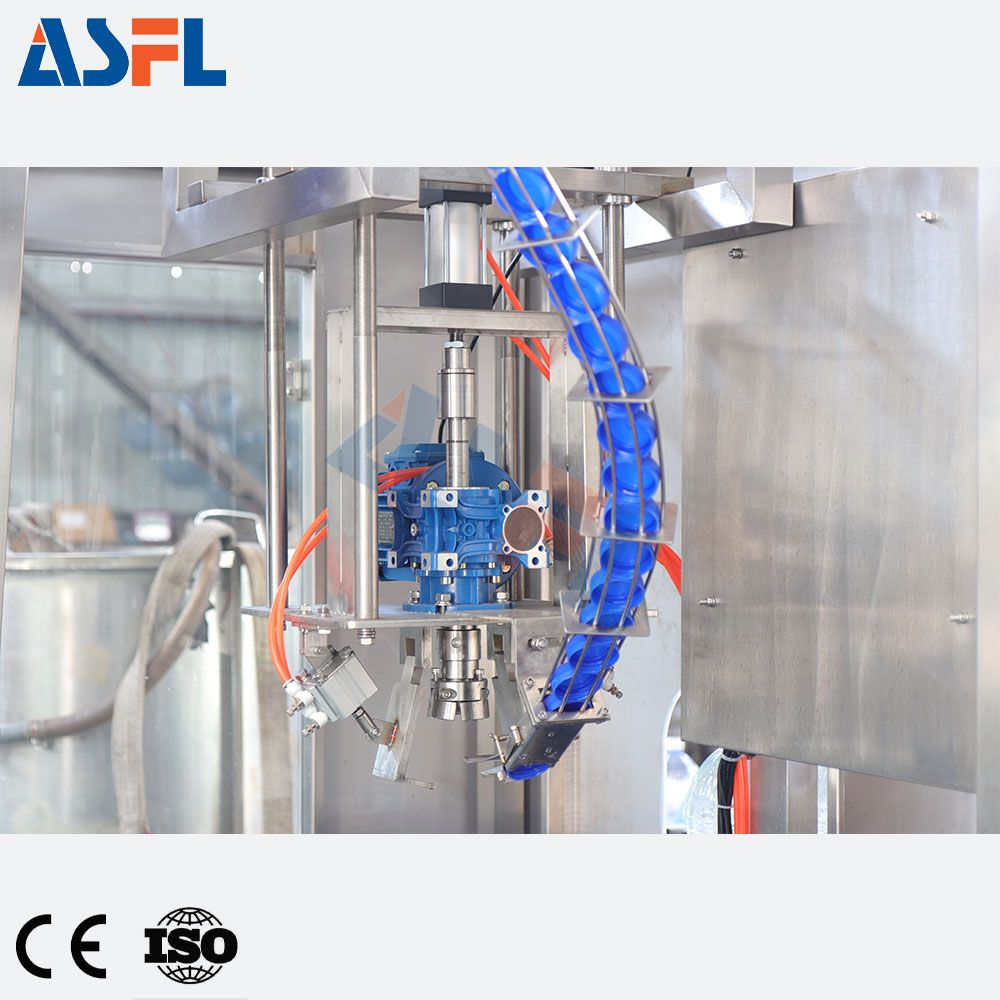
A high-speed fully automatic water bottle filling machine incorporates magnetic hysteresis capping heads or multi-axis servo motors that apply constant, pre-calibrated rotational force to plastic screw caps.
-
Magnetic Hysteresis Torque Clutches: Magnetic chucks slip smoothly upon reaching the set torque limit, preventing plastic cap thread stripping while maintaining precise tightening torque.
-
Automatic Cap Elevator and Sorting: Vibration hoppers and centrifugal cap sorters orient, sterilize, and feed plastic caps continuously into picking chutes, eliminating manual cap handling.
-
Neck-Gripping Anti-Rotation Starwheels: Precision starwheels grip bottle neck rings securely during capping rotation, preventing container twisting and protecting PET wall structures to preserve bottled water packaging consistency.
-
Real-Time Rejection Gate Systems: Downstream vision sensors inspect cap seating angle and tamper-evident ring integrity, rejecting mis-capped containers automatically to safeguard overall water bottle filling product consistency.
Environmental Hygiene Isolation and Microbiological Uniformity
Maintaining biological consistency is essential for commercial water bottlers complying with FDA 21 CFR 129, IBWA, and ISO 22000 standards. A fully automatic water bottle filling machine ensures microbiological stability by isolating rinsing, filling, and capping zones inside a sanitary stainless steel enclosure.
Overhead HEPA air filtration units supply a continuous downward laminar flow of sterile air, maintaining positive pressure inside the filling canopy. This positive air pressure prevents ambient factory dust, spores, and bacteria from entering open bottle mouths during transfer. Furthermore, automated Clean-in-Place (CIP) recirculation manifolds execute multi-stage hot caustic and acid washes without requiring manual line teardown, maintaining consistent internal surface cleanliness and supporting high automatic bottling line volume accuracy.
Quality Verification and Pre-Shipment Validation Testing
To verify that every fully automatic water bottle filling machine delivers optimal water bottle filling product consistency, ACE-FILLING subjects all automated monoblocks to strict Factory Acceptance Testing (FAT) protocols prior to dispatch.
-
Gravimetric Volumetric Audit: Dynamic checkweighers measure 1,000 consecutive filled containers at full operational line speed to verify net weight consistency within +/- 0.2 percent.
-
Dynamic Capping Torque Validation: Digital torque meters audit capped containers to confirm application torque remains within exact engineering limits (1.2 to 1.8 Nm for standard 28mm caps).
-
HEPA Air Laminar Velocity Testing: Anemometer sensors measure downward airflow across Class 100 ceilings to confirm steady laminar flow velocity between 0.36 and 0.54 m/s.
-
Continuous 24-Hour Trial Run: Automated monoblocks undergo continuous 24-hour dry and wet trials at maximum rated speed to confirm mechanical synchronization, low noise levels below 75 dB, and thermal stability across all electrical drives.
Water plant managers, project engineers, and beverage entrepreneurs seeking high-precision liquid packaging lines can review complete technical drawings and equipment specifications at the official
 Hot News








