 EN

How to evaluate cleaning efficiency of liquid filling and sealing machine CIP system
A clean-in-place programme is not proven simply because every valve sequence completed. For a liquid filling sealing machine, the useful question is whether the cycle repeatedly removes the relevant product soil from every product-contact zone without dismantling the equipment. That includes the feed path, pump or dosing path, filling valves and nozzles, manifolds, return path, and any surfaces where product can bridge between filling and sealing operations.
From a packaging-line engineering perspective, evaluate the liquid filling sealing machine as a connected circuit rather than a collection of clean-looking parts. A strong evaluation combines a documented cip cleaning process, representative sampling, process records, and an investigation method for any outlier. In other words, cycle completion is an input; verified cleanliness is the outcome.
Start by defining what “clean” means for this product and line
Cleaning efficiency has no useful single score until the acceptance target is defined. Begin with the previous product, the next product, the production schedule, and the risk that matters to the site. A low-viscosity beverage, a sugary syrup, a protein-containing product, and an oil-based liquid can leave very different residues in the same liquid filling sealing machine.
- Product-removal target: identify the residue or marker that must be removed from product-contact surfaces.
- Microbiological target: define the sampling approach and release criteria appropriate to the process risk. FDA guidance on cleaning validation notes that microbiological aspects of equipment cleaning should be considered whether or not CIP is used.
- Changeover target: specify the carryover concern, such as flavour, colour, allergen, active ingredient, or incompatible formulation.
- Operational target: set the repeatability requirement for cycle time, utilities, and result—not just the shortest possible run.
This step prevents a common mistake: declaring the liquid filling sealing machine clean because rinse water looks clear. Clear rinse water can be a useful observation, but it is not by itself evidence for hard-to-reach zones or a particular residue.
Map the complete CIP circuit before testing
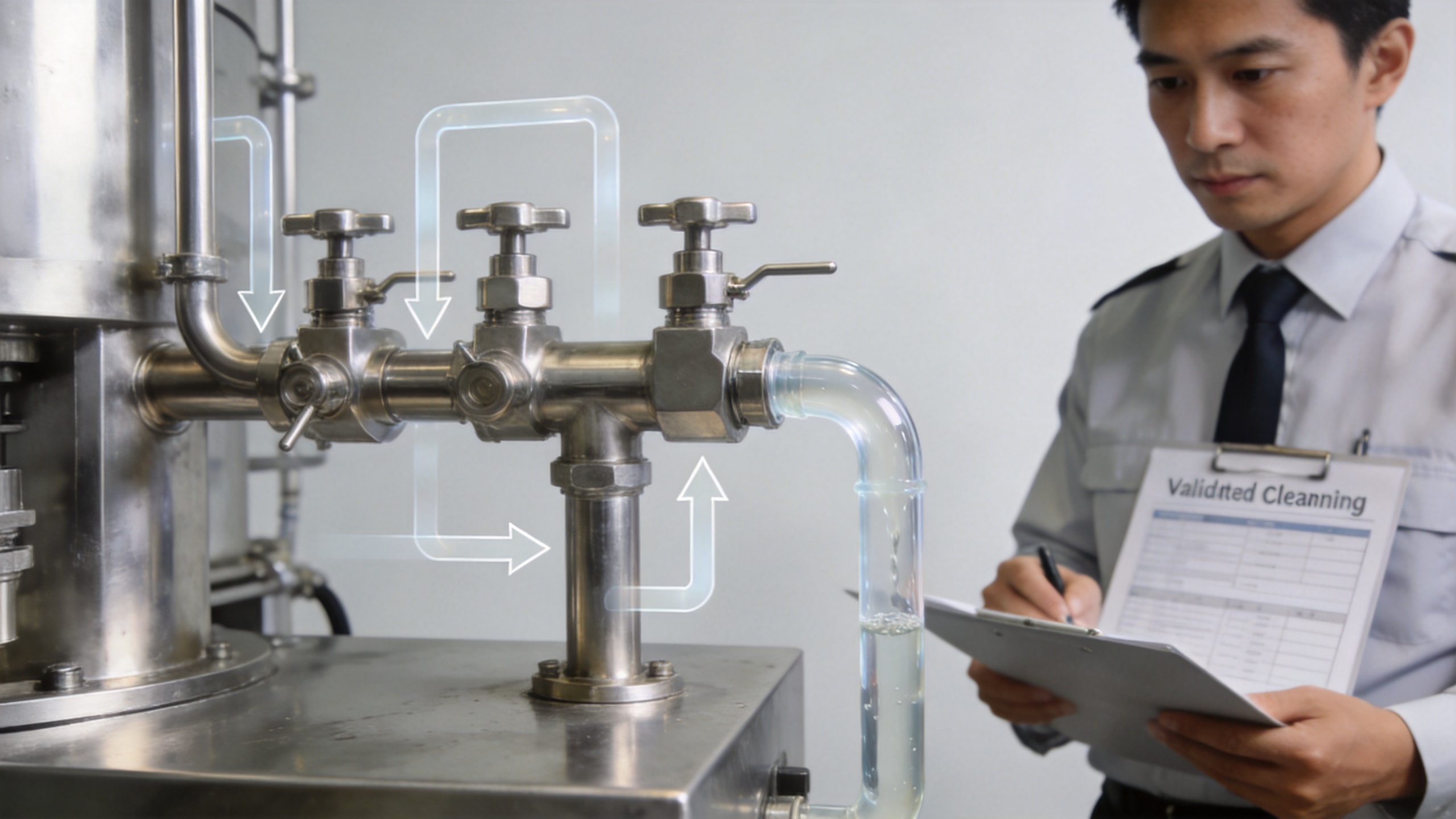
Build a line map showing where cleaning solution enters, how it travels, and how it returns. Include tanks, filters, valves, flexible connections, filler bowls, nozzles, recirculation branches, and return headers. For a combined filling-and-sealing line, distinguish true product-contact areas from external splash zones; both may need cleaning, but they should not be confused in the validation plan.
Then identify “worst-case” locations. These are commonly low-flow branches, elevation changes, dead-end sections, valve seats, nozzle tips, gaskets, and interfaces that retain product after normal draining. Change the perspective from “Did the recipe run?” to “What force, temperature, chemistry, and contact time reached this location?” That shift from single-machine parameters to line interfaces is especially important when upstream tanks or downstream closures affect the available cleaning window.
Verify the inputs to the clean in place process
A clean in place process is repeatable only when its critical inputs are controlled. Record the actual values from the validated cycle, not nominal setpoints copied from a recipe screen. The record should show:
- pre-rinse condition and drain status;
- cleaning chemical identity, concentration, and lot or preparation record;
- supply and return temperature at meaningful points;
- flow or pressure evidence that supports adequate circuit coverage;
- each phase’s start time, hold time, and completion status;
- final-rinse condition and any conductivity or other site-approved endpoint check.
There is no universal time or temperature that proves a liquid filling sealing machine is clean. The correct limits depend on soil, detergent, materials of construction, circuit geometry, utilities, and the line’s validated method. If the actual values fall outside the approved range, treat the cycle as an exception requiring assessment—not as a successful cycle with a minor note.
Use layered evidence instead of a single inspection
Visual checks are still valuable, particularly after a difficult product or a maintenance event. However, they should be one layer in the evidence package. A practical initial study for a liquid filling sealing machine can combine the following:
- Visual inspection: inspect accessible high-risk locations under defined lighting and acceptance criteria.
- Rinse sampling: collect at a defined point after the final rinse, using a method suitable for the residue or risk being assessed.
- Swab sampling: target justified worst-case surfaces where access is possible and where rinse data may dilute a local issue.
- Microbiological verification: use the site-approved method when the product and process risk require it.
- Repeat runs: demonstrate consistency across representative production and cleaning conditions rather than accepting a single favorable result.
Hygienic design evidence is helpful, but it has a boundary. EHEDG describes its test methods as assessments of hygienic and aseptic suitability rather than proof of performance in every application. Apply the same discipline here: good design supports cleanability, while the site’s own study verifies the implemented cip cleaning process.
Challenge the liquid filling sealing machine under representative worst cases
Select challenges that reflect real operating risk. For example, test after the longest normal run, after the most tenacious approved product, after a short planned stop, or at the end of a production campaign. Also consider the container and seal format if it changes the nozzle arrangement, splash pattern, or accessible cleaning geometry.
Do not make a “worst case” label based on intuition alone. Document why the selected product, soil load, location, and operating condition are difficult to clean. If a filling machine working principle changes—for example, through a different dosing arrangement or valve configuration—review whether the original CIP assumptions still apply. A hardware modification, different detergent, altered flow path, or new product family can all trigger a focused re-evaluation.
Turn failures into zone-specific corrective actions
When a result fails, avoid immediately extending every phase of the CIP recipe. First isolate the pattern. A failure at one nozzle may point to local flow distribution, orientation, spray coverage, or a valve-seat issue. A broad residue pattern may point to chemistry, temperature, concentration, or inadequate pre-rinse removal. Repeated final-rinse anomalies may indicate incomplete draining, carryover from a return path, or a sampling-method problem.
| Observed pattern | Questions to investigate | Typical next action |
|---|---|---|
| One recurring location fails | Is it a low-flow or retained-product zone? Did a valve actuate correctly? | Confirm local coverage and inspect the component; then repeat a targeted verification. |
| Many locations show residue | Were chemistry, temperature, flow, and phase time within approved limits? | Review cycle records and solution preparation before changing the recipe. |
| Results vary between runs | Did product, utilities, operator preparation, or line configuration change? | Compare actual cycle data and restore a controlled, repeatable condition. |
Release a practical CIP evaluation checklist
Before approving routine use, make sure the team can answer yes to each point below:
- The product-contact circuit and worst-case locations are mapped and justified.
- Acceptance criteria fit the product and cross-contamination risk.
- Actual CIP parameters are recorded and reviewed against approved ranges.
- Visual, rinse, swab, and microbiological evidence are used where appropriate.
- Results are repeatable across representative challenges.
- Exceptions have documented investigation, corrective action, and re-verification.
- Maintenance and product changes have a defined impact-review path.
A well-evaluated liquid filling sealing machine CIP system does more than shorten a cleaning window. It gives the operations, quality, and engineering teams a defensible way to show that the right cleaning conditions reached the right surfaces and produced repeatable evidence. That gives the team a sound basis for improving efficiency while keeping product protection in view.


 Hot News








