 EN

What Quality Control Steps Should a Mineral Water Bottling Machine Run Every Shift?
A mineral water bottling machine should not be judged only by whether bottles come off the conveyor. Each shift needs a repeatable quality-control routine that confirms hygienic conditions, stable filling, reliable closures, readable codes, and usable records. From an operator’s viewpoint, the useful question is not “Is the line running?” but “Can we show that it ran within the plant’s validated limits?”
The exact checks, limits, and sampling frequency must come from the site’s HACCP or GMP program, equipment manuals, and local regulations. The checklist below is a practical operating framework, not a substitute for those approved instructions.
1. Start with a documented pre-shift release
Before product enters the mineral water bottling machine, the shift lead should verify that the line is released for production. Walk the product path from bottle infeed through rinsing, filling, capping, coding, labeling, and discharge. Check that guards, sensors, drains, and conveyor transfer points are clean, intact, and free of loose parts or standing water.
- Confirm the previous product, bottle, cap, label, and lot materials have been cleared or formally changed over.
- Review the completed cip cleaning process or sanitation record, including the authorized chemical, concentration or other validated verification result, contact time, and operator sign-off.
- Inspect product-contact areas for residue, scale, damaged seals, or oxidation. If an unsanitary condition is found, clean and sanitize before release rather than starting and correcting later.
- Verify utilities required by the validated process: product water supply, compressed air condition, power, and any treatment or disinfection systems that apply to the line.
- Record the line, date, shift, product, bottle format, and responsible personnel in the shift log.
For U.S. plants, 21 CFR Part 129 is a useful reference point: it requires clean, adequately sanitized product-water contact surfaces and records of relevant inspections. Plants outside that jurisdiction should use the equivalent local requirements and their own approved sanitation program.
2. Verify the first acceptable bottles, not just the first running bottles
Run the line at the planned startup condition and segregate the first bottles until the quality checks are complete. The mineral water bottling machine can be mechanically ready while bottle handling or closure settings are still settling. Inspect enough consecutive containers to reveal a recurring problem rather than approving a single good-looking sample.
Container and rinse checks
- Look for cracked, deformed, contaminated, or incorrectly oriented bottles before filling.
- Confirm the rinser or bottle preparation stage is operating as specified for the chosen container type.
- Check that bottle necks transfer cleanly into the filler without scuffing, misalignment, or a buildup at the starwheel.
Fill and cap checks
- Measure fill level, net content, or another approved fill-control characteristic against the plant limit.
- Inspect for drips, splashing, foam carryover, and leakage immediately after filling and after capping.
- Check cap presence, skew, thread engagement, tamper-band condition, and closure torque or another approved closure verification.
- Compare several heads or stations. A defect that follows one filling valve or capper head needs a station-specific response, not a general adjustment.
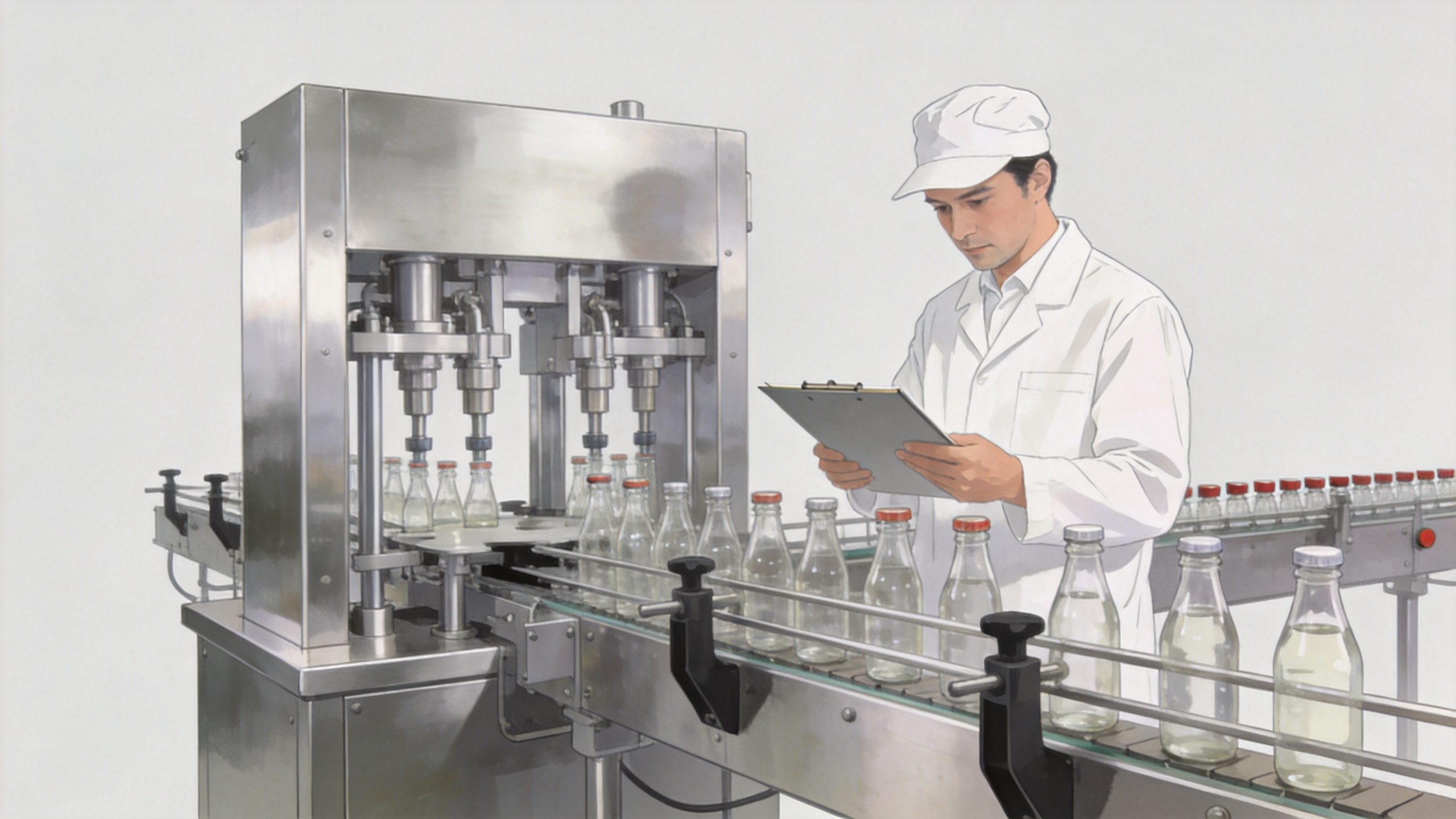
Filling and capping should be observed together. A leak may begin with a fill-height variation, but it can also result from cap delivery, bottle-neck dimensions, or capper setup. Treating every closure issue as a filler issue wastes time and can hide the real cause.
3. Check the line at planned intervals throughout the shift
After startup approval, use a timed or lot-based schedule defined by the quality plan. The interval should be short enough to catch drift before a large quantity is produced. On a high-output line, operators often pair routine visual checks with periodic measured checks and a documented response for any out-of-limit result.
| Control area | What to verify | What to record |
|---|---|---|
| Product path | Leaks, unusual foam, temperature or pressure indications where applicable | Time, reading, affected station, action taken |
| Container integrity | Bottle damage, neck finish condition, contamination, handling stability | Sample size, defect type, quantity held or rejected |
| Fill control | Approved fill characteristic against the line limit | Results by head or sampling point and adjustment verification |
| Closure | Cap presence, alignment, tamper evidence, torque or validated alternative | Sampling result, capper head, corrective action |
| Pack identity | Lot code, date code, label identity, legibility, placement | Code sample or verification result and any rework decision |
Filling machine calibration belongs in the preventive system as well as the shift check. Operators should not recalibrate a line merely to make a result look acceptable. Follow the approved adjustment process, identify the affected production window, and verify the corrected condition with a new sample.
4. Make coding, labels, and traceability part of QC
A safe, properly filled bottle can still become a release problem if the lot code is missing or the label is wrong. At startup, after any changeover, and at the scheduled verification interval, compare the printed information with the production order. Check legibility on the actual bottle surface, not only the printer display.
- Verify product name, label version, lot or production code, and date format as required by the approved artwork and market rules.
- Confirm the code is permanent enough to be read after normal handling and does not overlap a seam or graphic that makes it ambiguous.
- Retain the required sample or record according to the site’s traceability procedure.
21 CFR Part 129 provides one example of the importance of records: it calls for documentation of product type, volume, production date, lot code, and distribution information, as well as sampling details and analysis results. The site record should make it possible to identify the product window affected by an exception.
5. Respond to a deviation with a hold-and-verify sequence
A sound response is specific and calm. Stop or slow the relevant equipment when the approved procedure requires it, identify the last known good check, isolate potentially affected bottles, and notify the assigned quality or maintenance role. Record the condition at the process node where it appeared: rinser, filler, capper, coder, labeler, or conveyor transfer.
- Contain the affected product and mark the time or lot range.
- Correct the confirmed cause using the authorized procedure.
- Recheck the relevant quality attribute with a documented sample.
- Decide disposition of held product through the plant’s quality process; do not release it based on a verbal assurance.
- Log the abnormality, root-cause findings if required, and preventive follow-up.
This discipline supports bottling line efficiency. It may feel slower at the moment, yet a small, traceable hold is usually less disruptive than a broad investigation after mixed production has moved downstream.
6. Close the shift with a handover that preserves control
At shift end, reconcile production and rejects, review open deviations, and communicate any settings or maintenance concerns to the next team. A clean handover should state the current product and format, last verified check, material status, equipment condition, and any product on hold. If the line will be cleaned or changed over, document the status so the next release does not rely on memory.
A mineral water bottling machine performs more consistently when quality control is built into normal operating rhythm: release, verify, monitor, contain, and hand over. Use the checklist as a starting point, then tailor every limit and escalation rule to the validated process for your plant.
7. Put the checklist into a usable shift form
For every mineral water bottling machine, turn the routine into a one-page controlled form. The form should identify the line and product, list the approved checks in the order the operator performs them, and provide space for actual readings rather than a row of pre-checked boxes. A mineral water bottling machine shift record is most useful when a supervisor can see the condition, time, responsible person, and response without reconstructing the event from memory.
Include the completed cip cleaning process release, the approved filling machine calibration verification, and the bottling line efficiency exceptions that affected quality. This does not mean repeating a full maintenance record on every form. It means linking the routine check to the correct equipment or quality record so that the mineral water bottling machine has a traceable operating history.
8. Use a simple ownership matrix
Quality control becomes more reliable when the owner of each action is clear. The line operator normally performs routine observations on the mineral water bottling machine; quality personnel review defined samples and disposition decisions; maintenance addresses verified mechanical faults. When an abnormal result occurs, the person who discovers it records the time, the exact station, and the immediate containment. The decision to release held product stays with the authorized quality process.
That separation protects both bottling line efficiency and product control. It prevents a well-intentioned operator from making an undocumented setting change, and it ensures that recurring faults on the mineral water bottling machine are visible to the people who can remove the root cause.

 Hot News








