 EN

What Regulatory Requirements Govern Packaged Drinking Water Plant Machinery?
A packaged drinking water plant is not compliant simply because it can rinse, fill, cap, and label bottles. Compliance is the combined result of the destination market’s food rules, machinery rules, food-contact-material requirements, hygienic design, validation records, and the way the plant is operated. From a packaging-line engineering perspective, the useful starting point is to define the water, bottle, closure, output rate, and destination country before deciding which certificates or design features are required.
That distinction matters. A machine builder can supply equipment designed for hygienic operation, but the bottler normally remains responsible for plant licensing, source-water approvals, sanitation programs, product testing, labeling, and local inspections. This overview explains the regulatory questions a buyer should put into a packaged drinking water plant specification. It is educational guidance, not legal advice; confirm the current rules with the competent authority and a qualified compliance professional in every target market.
Start with the jurisdiction and product classification
There is no single global approval that makes a packaged drinking water plant lawful everywhere. The relevant framework changes with the country where the product will be placed on the market, whether the water is treated water, spring water, mineral water, or another defined category, and whether the project includes processing, bottling, or both.
For example, U.S. bottlers should assess the Food and Drug Administration framework for bottled water, including 21 CFR Part 129 and the applicable current good manufacturing practice requirements. Part 129 addresses facilities, sanitary operations, equipment, and process controls. In the European Union, the assessment may include food hygiene obligations, machinery conformity requirements, and the food-contact-material framework under Regulation (EC) No 1935/2004, alongside national implementation and water-category rules. Other countries may require separate plant registration, sanitary permits, local standards, inspections, or recognized third-party documentation.
Ask the compliance lead to create a destination-market matrix before a packaged drinking water plant is ordered. The matrix should name the product category, authority, applicable standard or regulation, evidence required, owner of each obligation, and the point at which evidence must be reviewed. It prevents a common error: treating a general machinery declaration as proof that a finished bottled-water operation may begin production.
Hygienic equipment design is a core requirement
Regulators commonly focus on whether product-water contact surfaces and the surrounding process can be kept sanitary. Under U.S. 21 CFR 129.40, equipment used to store, handle, process, package, or transport product water must be suitable for its intended use. The provision also states that product-water contact surfaces must be nontoxic, nonabsorbent, capable of adequate cleaning and sanitizing, and compliant with the applicable food-contact provisions.
For a packaged drinking water plant, translate that rule into a machine-review checklist:
- Identify every wetted material in tanks, piping, valves, filler bowls, nozzles, gaskets, hoses, filters, and fittings.
- Request material declarations and traceability where the destination market or customer specification calls for them.
- Review surface finish, dead-leg risk, drainage, access for inspection, and the ability to disassemble or clean critical parts.
- Confirm that cleaning and sanitizing methods are compatible with the materials, seals, controls, and intended chemistry.
- Check separation between raw-water, treated-water, cleaning, compressed-air, and waste paths to reduce cross-contamination risk.
Stainless steel is often specified for wetted components, but “stainless” alone is not a compliance conclusion. The grade, seal material, fabrication practice, weld finishing, cleaning chemistry, documentation, and intended service all need to be checked against the applicable requirement. In other words, first verify hygienic contact conditions, then verify throughput.
Cleaning, sanitation, and maintainability must be designed in
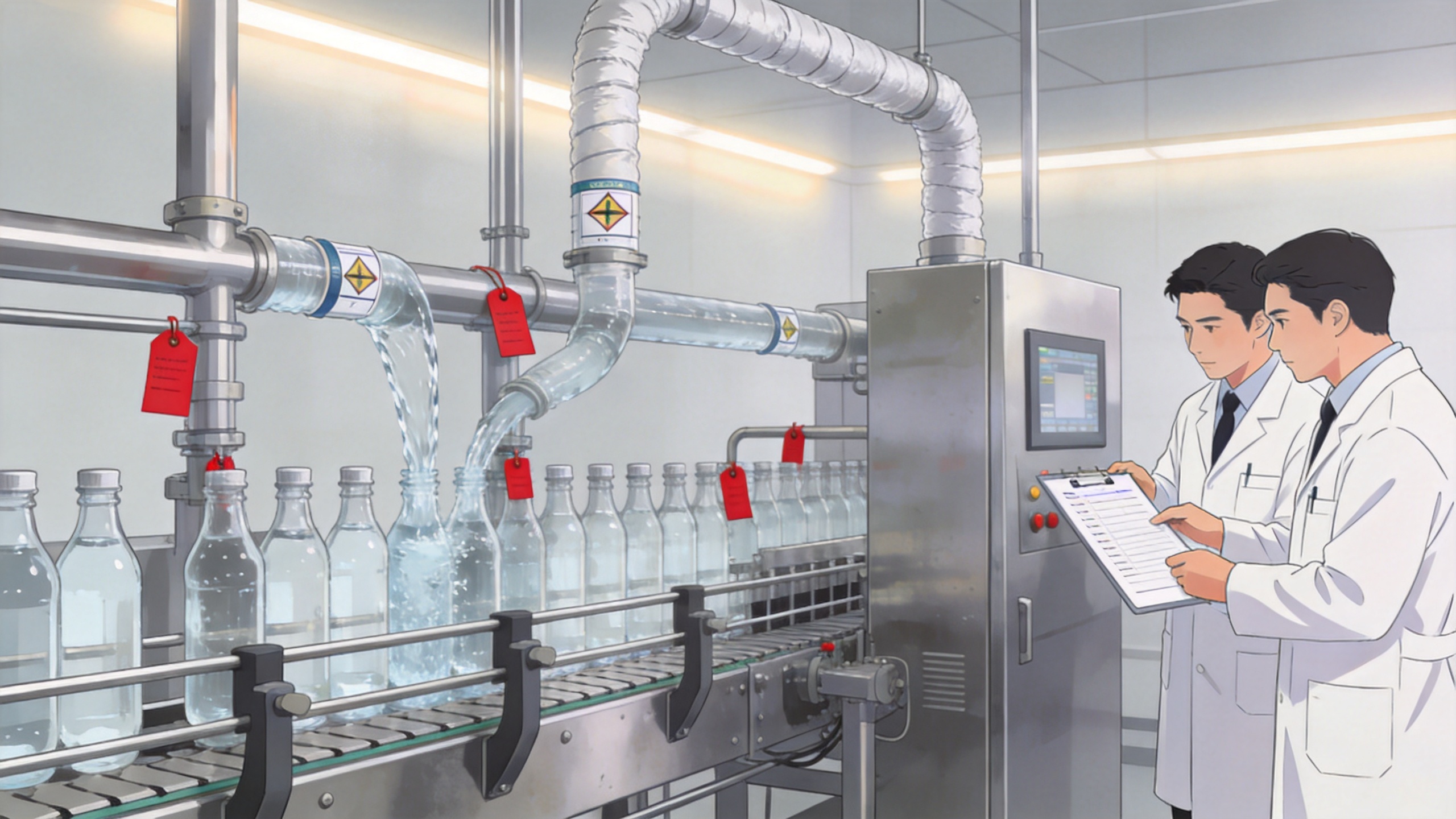
A packaged drinking water plant should support the plant’s sanitation program rather than rely on manual workarounds. FDA bottled-water rules describe the need to keep product-water contact surfaces clean and adequately sanitized, inspect them as necessary, and remedy scale, oxidation, residue, or unsanitary conditions before use. These duties affect equipment details such as drainability, access doors, removable parts, CIP routing, spray coverage, sample points, and the ability to isolate a section for maintenance.
During technical clarification, require the supplier to explain the cleaning sequence, utilities needed, proposed cleaning agents, temperature or concentration limits where applicable, drain points, and verification points. A diagram of the actual flow path is more useful than a generic statement that the line is “easy to clean.” If a CIP system is included, define what it covers and what remains a manual sanitation task. If it is not included, document the validated manual procedure and the downtime it requires.
Machinery safety and food safety are related, but different
Food-contact and sanitation requirements do not replace machinery-safety obligations. A packaged drinking water plant also needs an assessment of guards, emergency stops, electrical safety, pneumatic hazards, noise, safe access, lockout procedures, control-system behavior, and guarding around conveyors, cap elevators, blowers, and rotating equipment. The exact legal route depends on the market. In the EU, for instance, machinery conformity documentation and the applicable CE obligations must be assessed separately from food-contact compliance; in other markets, local electrical or occupational-safety rules may control.
Buyers should request a hazard-based file that states the assumed installation conditions and residual risks. It should cover the whole line, not only the filler. The interfaces between treatment, bottle handling, rinsing, filling, capping, labeling, packing, and conveyors are often where practical safety and sanitation issues appear.
Build a documentation package before factory acceptance
For a packaged drinking water plant, reviewable evidence matters more than marketing language. A procurement specification should identify which documents are required before shipment, during factory acceptance testing, at site commissioning, and after validation. Typical requests include:
- General arrangement, process-flow, piping, electrical, pneumatic, and utility drawings.
- Wetted-parts list and relevant food-contact declarations for the destination market.
- Cleaning and sanitation instructions, preventive-maintenance plan, spare-parts list, and operator training records.
- Risk assessment, safety instructions, control documentation, and conformity documents required for the destination.
- Factory acceptance protocol showing the agreed test conditions, plus a site acceptance and commissioning plan.
- Calibration, inspection, and validation responsibilities for critical controls such as treatment, rinsing, filling, capping, and closure integrity.
Documentation must match the supplied configuration. A generic manual or declaration for a different line layout is a gap, not a substitute for project-specific evidence.
Separate machine acceptance from regulatory authorization to operate
Factory acceptance can demonstrate that a packaged drinking water plant performs the agreed mechanical functions under specified conditions. It does not automatically demonstrate that the bottler has completed water-source approvals, environmental permissions, food-business registration, employee hygiene controls, laboratory testing, labeling review, or local inspection. Those are plant-level responsibilities that should be scheduled in parallel with equipment delivery.
Use a two-part commissioning plan. The first part confirms installation, utilities, equipment functions, sanitation access, and safety controls. The second part confirms the operational controls demanded by the relevant authority: water-quality monitoring, cleaning records, sampling, corrective actions, traceability, and release procedures. This approach makes it easier to spot an unresolved regulatory duty before commercial production begins.
A practical buyer checklist
Before releasing a packaged drinking water plant purchase order, ask these questions:
- Which destination-market rules apply to the water category, machine, and food-contact components?
- Which party owns each permit, declaration, validation, test, and inspection?
- Can the wetted path be cleaned, sanitized, drained, inspected, and documented under the intended operating conditions?
- Are the safety and hygienic-design requirements coordinated across the complete line?
- Does the acceptance protocol test the same bottles, caps, water conditions, and production assumptions used in the regulatory plan?
A well-specified packaged drinking water plant helps a bottler collect better evidence, control sanitary risks, and prepare for local review. It cannot replace regulatory ownership. Define the market first, document the exact equipment configuration, and validate the whole process with the people responsible for food safety and legal compliance.

 Hot News








